
Shoulder Labral Tear
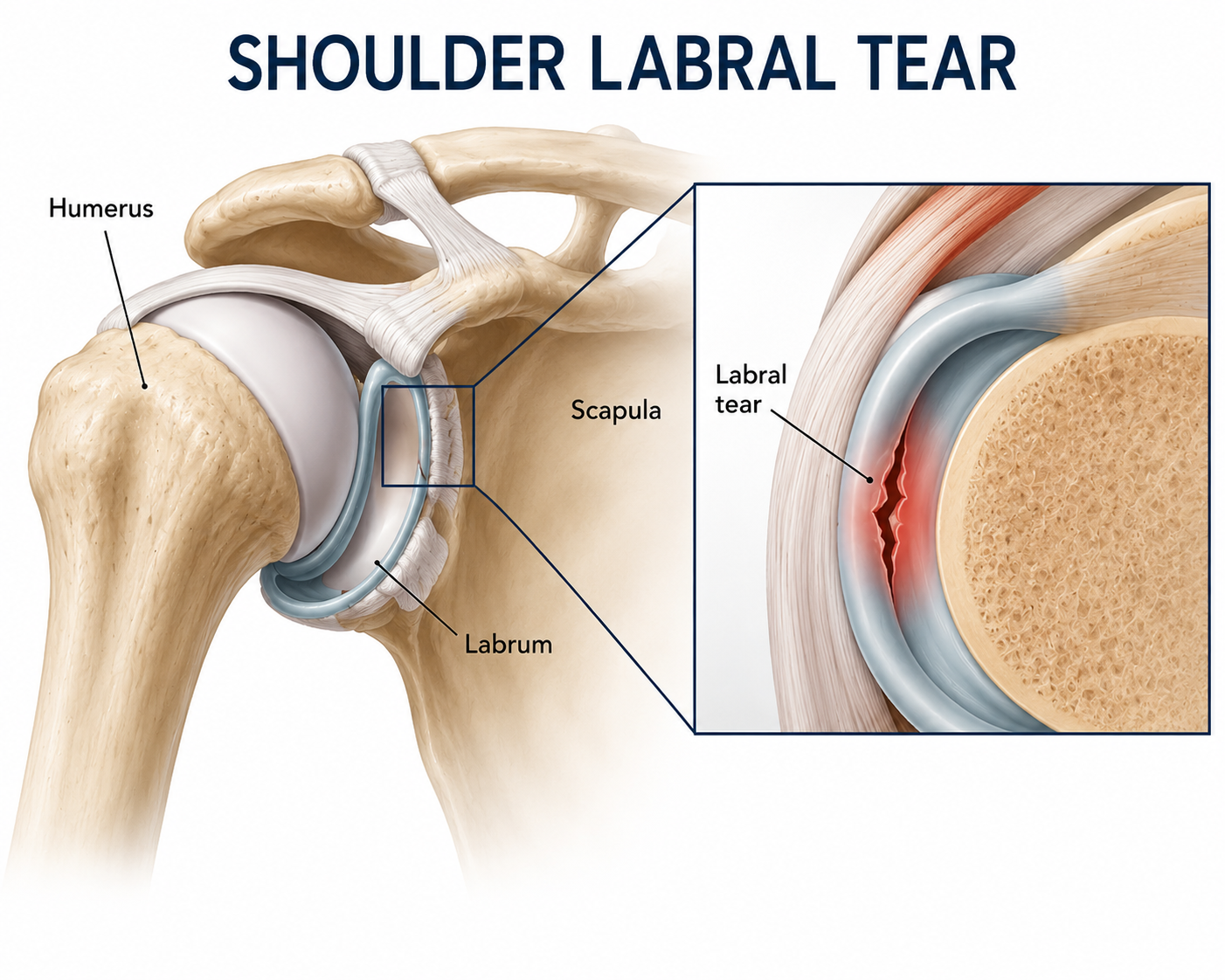
Shoulder Labral (SLAP) Tear
A shoulder labral tear is damage to the ring of cartilage (the labrum) that surrounds and stabilizes the shoulder socket, causing pain, clicking, weakness, and a sensation that the shoulder is slipping. Most labral tears require imaging with MRI or MR arthrogram to diagnose accurately. At Aptiva Health, fellowship-trained sports medicine orthopedic surgeons Dr. Steve Smith - who trained at the Kerlan-Jobe Orthopaedic Clinic, the program that produces team physicians for the Los Angeles Dodgers, Lakers, and Rams - and Dr. Timothy Wilson treat labral tears with physical therapy, fluoroscopy-guided injections, and arthroscopic SLAP and Bankart repair across Louisville, Lexington, Northern Kentucky, Elizabethtown, Mt. Washington, and Indianapolis, with same-day appointments available.
Medically reviewed by Steve Smith, MD, and Timothy Wilson, MD. Last reviewed: May 2026.
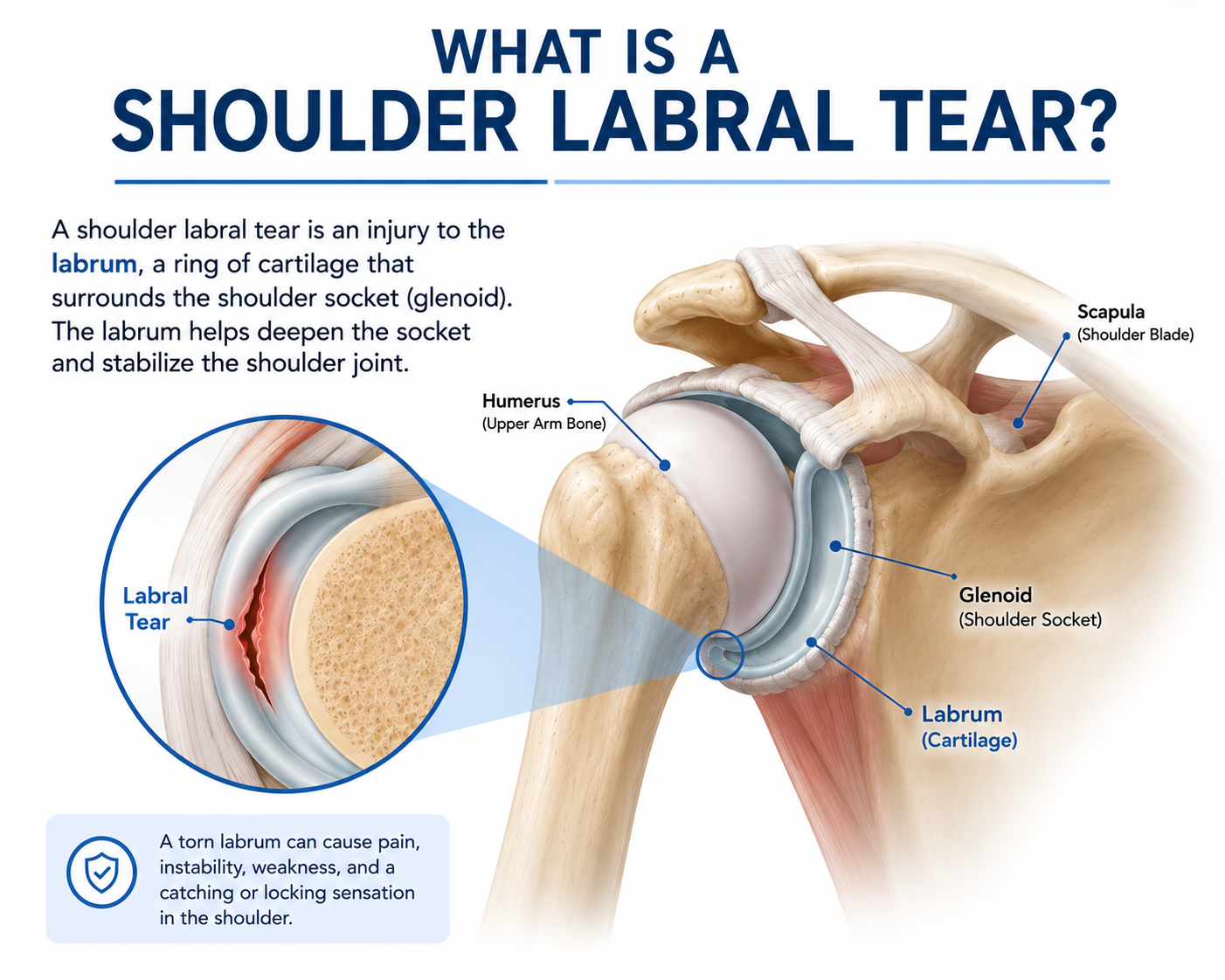
What is a shoulder labral tear?
The labrum is a ring of cartilage that surrounds the rim of the shoulder socket, called the glenoid. The labrum deepens the otherwise shallow socket and helps hold the ball of the upper arm bone (the humeral head) in place. It also serves as the anchor point for the long head of the biceps tendon at the top of the socket, and for the ligaments that hold the shoulder stable on all sides.
A shoulder labral tear is a tear in that ring of cartilage. Labral tears are named by their location:
A SLAP tear (Superior Labrum Anterior-Posterior) is a tear at the top of the labrum, where the biceps tendon attaches. SLAP tears are most common in overhead athletes such as throwers, swimmers, and racquet sport players, and in patients who fall onto an outstretched arm.
A Bankart tear is a tear at the front-lower part of the labrum and is the classic injury that follows an anterior shoulder dislocation.
A posterior labral tear is a tear at the back of the labrum, less common than SLAP or Bankart, and more often seen in football linemen and in patients with repetitive bench-press injuries.
Other labral tears - including degenerative tears that develop with age - can occur anywhere along the rim. Accurate identification of where the tear is and what is attached to it is what determines whether it can be managed without surgery and, if surgery is needed, what type of repair is appropriate.
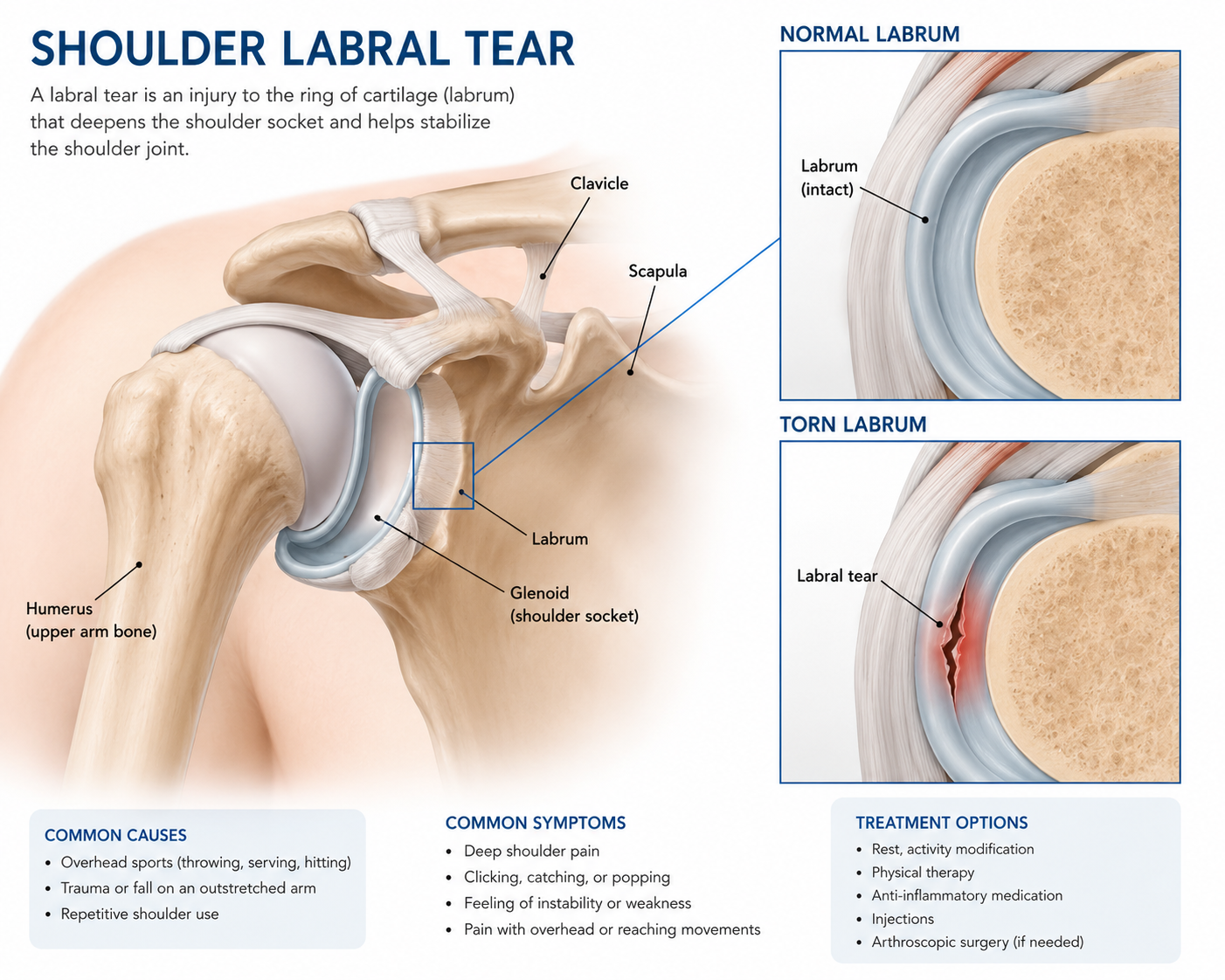
What does a shoulder labral tear feel like? Common symptoms:
Labral tear symptoms vary depending on the location of the tear and whether there is associated shoulder instability. The most common symptoms are:
Deep shoulder pain - often described as a catching or clicking sensation with arm motion, particularly overhead.
A sense that the shoulder is loose, slipping, or about to come out of place (instability).
Weakness with overhead activities such as throwing, swimming, lifting, or reaching.
Pain when reaching behind the back or putting on a coat.
Decreased range of motion in the affected shoulder.
Popping, grinding, or clunking sensations in the joint.
Night pain, particularly when sleeping on the affected side.
For overhead athletes - a specific complaint of "dead arm" or loss of throwing velocity.
Labral tears often coexist with rotator cuff tears, biceps tendon problems, and shoulder impingement. Pinpointing which structure is responsible for which symptom requires a focused physical examination and, in most cases, advanced imaging.
What causes a shoulder labral tear?
Labral tears are caused by either a single traumatic event or repetitive overhead stress. The most common mechanisms we evaluate at Aptiva Health are:
Shoulder dislocation or subluxation - the classic cause of a Bankart tear. The labrum tears off the front of the socket when the humeral head shifts forward.
Falling onto an outstretched arm - a sudden axial load that can tear the superior labrum (SLAP tear).
Repetitive overhead motion - throwing, swimming, tennis, volleyball, and weightlifting can fatigue and tear the superior labrum over time.
Direct blow to the shoulder - a hit, fall, or collision that compresses the joint.
Sudden pulling on the arm under load - for example, catching yourself on a railing as you fall.
Age-related labral degeneration - the labrum thins with age and can develop tears with relatively minor stresses after 40.
Recurrent shoulder dislocations - each dislocation enlarges or worsens an existing Bankart lesion and increases the chance of future instability.
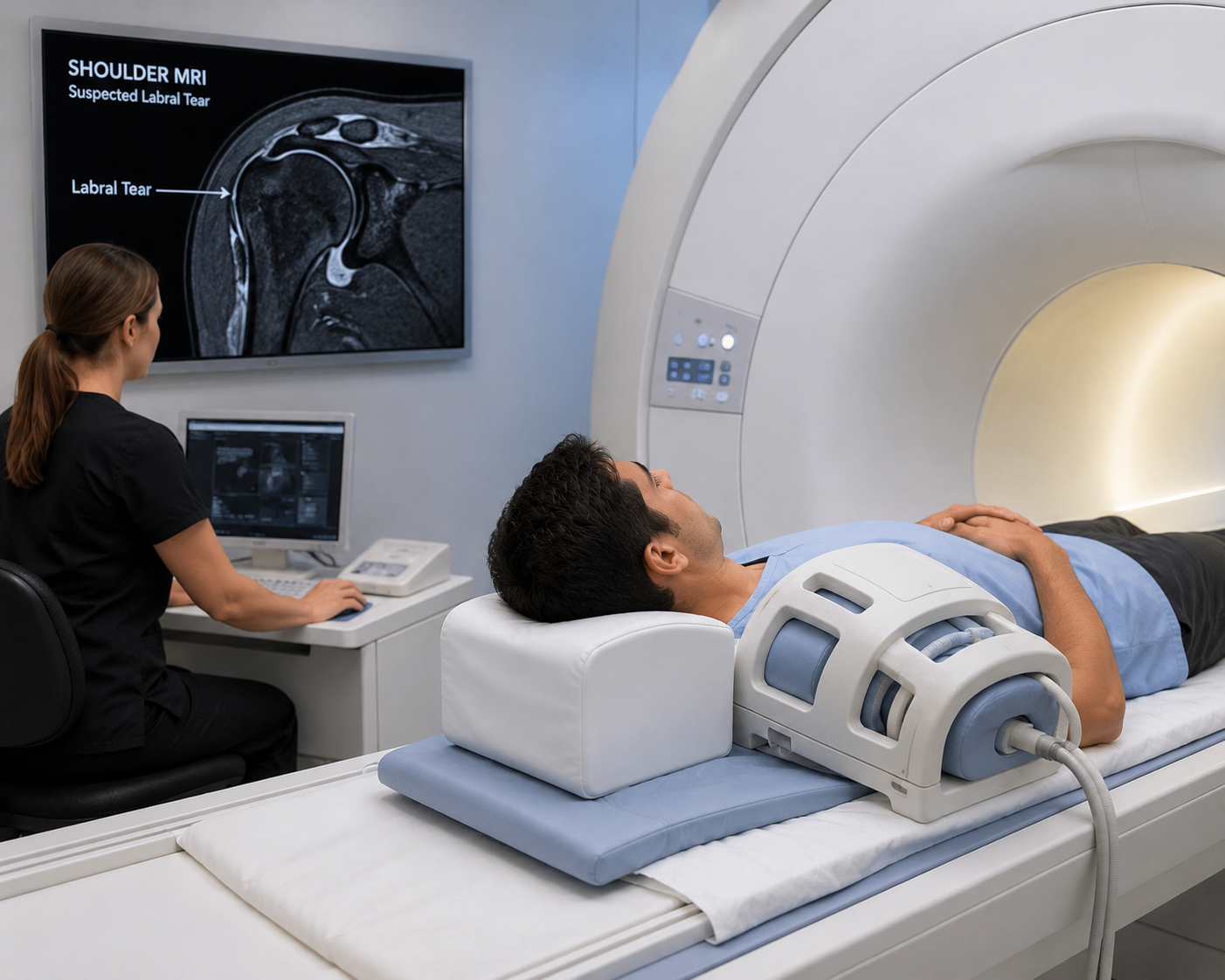
How is a shoulder labral tear diagnosed at Aptiva Health?
Diagnosing a labral tear is a two-step process: first confirming that the labrum is the source of the symptoms, and second identifying exactly where in the labrum the tear is located. At Aptiva Health, your evaluation typically includes:
A detailed history. Your surgeon will ask about the inciting event (a dislocation, a fall, a specific throwing motion), the pattern of pain, and any sense of instability or popping. Athletes are asked detailed questions about sport, position, and the arm motions that reproduce symptoms.
A focused physical examination. Specific provocative tests are highly informative for labral pathology - including the O'Brien active compression test for SLAP tears, the anterior apprehension and relocation tests for anterior instability and Bankart lesions, the Speed test for biceps tendon involvement, and the load-and-shift test for capsular laxity. The pattern of which tests reproduce pain often pinpoints the tear location before any imaging is done.
Imaging.
Most non-contrast MRI scans are now sensitive enough to show the majority of labral tears.
MR arthrogram - an MRI performed after contrast is injected directly into the shoulder joint - is sometimes utilized for labral tears because the contrast outlines the labrum clearly and shows whether the tear extends through the full thickness.
X-rays are obtained to look for bone loss on the glenoid rim (associated with recurrent Bankart lesions) and any associated bony Bankart fractures or Hill-Sachs lesions.
Aptiva Health offers on-site MRI at our Louisville, Lexington and northern Kentucky imaging centers. Most patients are imaged within the same week as their first visit - so the evaluation, MRI, and treatment plan can often be completed across a single week instead of multiple separate referrals.
How is a shoulder labral tear treated?
Treatment depends on which type of labral tear is present, how severe the symptoms are, and the patient's activity demands. Aptiva Health's shoulder team uses a stepped-care approach: we start with the least-invasive option appropriate to the tear, and progress to more advanced interventions only when conservative care is not enough. Many labral tears - especially small or partial tears - can be successfully managed without surgery. Surgical repair is reserved for athletes returning to overhead sport, patients with recurrent instability, and tears that have not responded to several months of conservative care.
Non-surgical labral tear treatment
First-line care for many labral tears is non-surgical. Aptiva Health coordinates these options under one roof, so you do not have to manage care across separate practices:
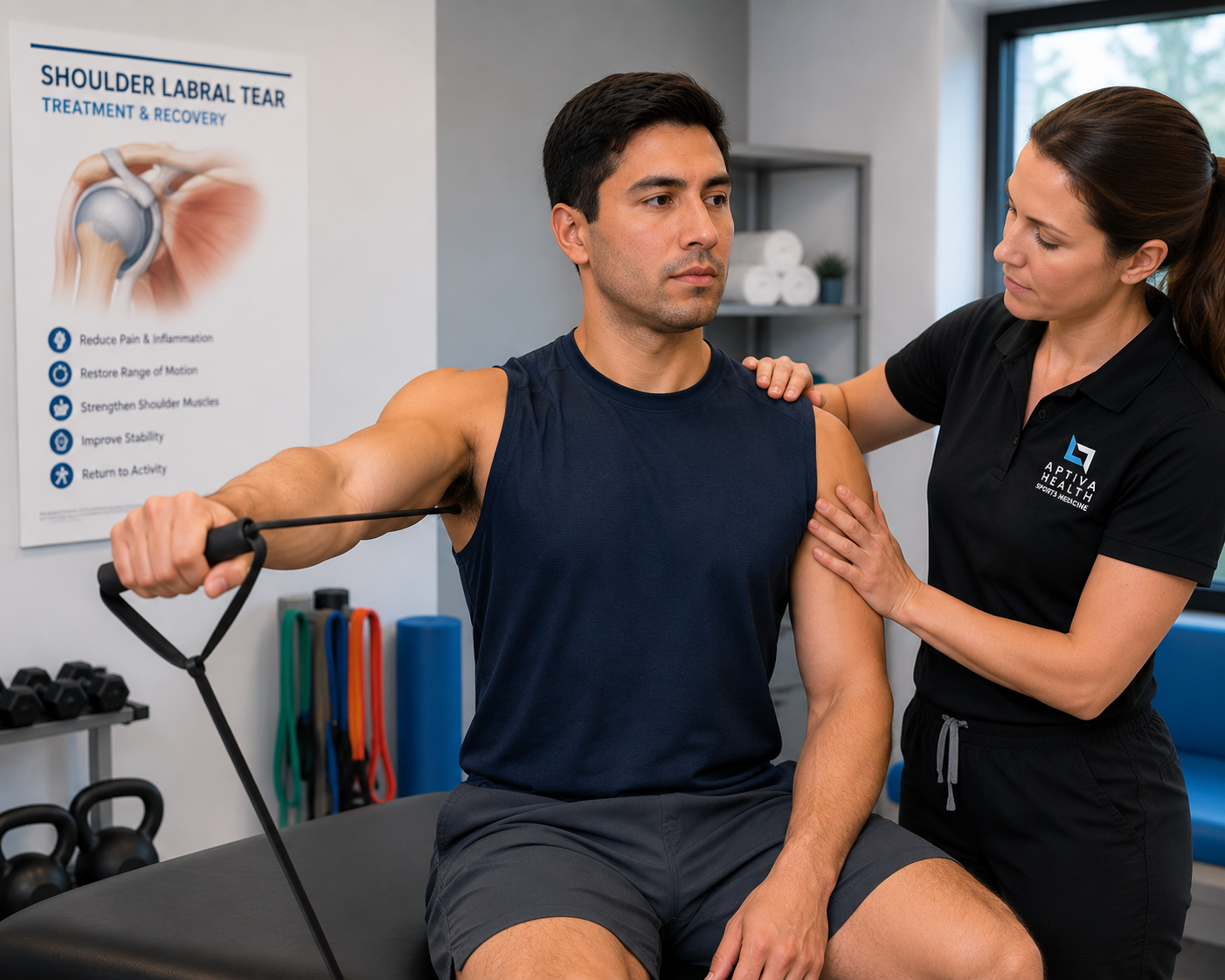
Physical therapy - Aptiva's in-house shoulder physical therapy team uses targeted exercises to strengthen the rotator cuff and scapular stabilizers, which take pressure off the labrum and the glenohumeral joint.
Activity modification - short-term avoidance of the specific motions that aggravate the tear (often overhead lifting, throwing, or contact).
Anti-inflammatory medication - NSAIDs such as ibuprofen or naproxen for inflammation around the joint.
Sport-specific biomechanics correction - for throwers, swimmers, and racquet-sport athletes, working with Aptiva's sports medicine team to refine throwing or stroke mechanics that may have contributed to the tear in the first place.
Bracing or activity restriction - for first-time anterior dislocations, a sling for two to four weeks followed by structured rehabilitation.
Injection treatments for shoulder labral tears
When physical therapy and oral medication are not enough, image-guided injections can both diagnose and treat the source of pain. At Aptiva Health, these injections are performed by our interventional spine and pain physician Dr. Steven Ganzel - double board-certified in Physical Medicine and Rehabilitation and Interventional Pain Management - under fluoroscopic (live X-ray) guidance:
Glenohumeral joint corticosteroid injection - anti-inflammatory medication delivered directly into the shoulder joint, which often provides significant relief that lets the patient fully engage with physical therapy.
Diagnostic intra-articular injection - a local anesthetic delivered to the joint to confirm whether the joint itself (versus the subacromial space or biceps tendon) is the primary pain source. This helps distinguish labral pathology from rotator cuff or impingement pathology.
Biceps tendon sheath injection - for cases where biceps tendinopathy is contributing to the symptom pattern, common with SLAP tears.
Surgical treatment for shoulder labral tears
Surgery is considered when a labral tear does not improve with conservative care, when there is recurrent shoulder instability or repeat dislocations, when an athlete needs to return to overhead or contact sport, or when imaging shows a tear pattern that will not heal without repair.
Aptiva Health has three expertly trained shoulder surgeons - Dr. Steve Smith, Dr. Timothy Wilson, and Dr. Philip Stickney. Dr. Smith and Dr. Wilson are both fellowship-trained in orthopedic sports medicine and perform arthroscopic labral repair using small-incision techniques that minimize tissue damage and accelerate recovery. Dr. Smith completed his sports medicine fellowship at the Kerlan-Jobe Orthopaedic Clinic in Los Angeles - the program that trains team physicians for the Los Angeles Dodgers, Lakers, and Rams - and brings the same surgical techniques used to keep professional overhead athletes performing at the highest level. Dr. Wilson is double board-certified in Orthopaedic Surgery and Orthopaedic Sports Medicine.
The two most common labral repair procedures are:
Arthroscopic SLAP repair - through three to four small incisions, the torn portion of the superior labrum is either debrided (smoothed) or anchored back to the glenoid using bioabsorbable suture anchors. Restores the labrum's attachment and the function of the long head of the biceps tendon. Performed as outpatient surgery; most patients go home the same day.
Arthroscopic Bankart repair - through small incisions, the torn anterior-inferior labrum is mobilized and reattached to the front-lower glenoid rim using suture anchors, and the joint capsule is tightened to restore stability and prevent recurrent dislocation. Outpatient procedure. Recurrent dislocations are significantly less common after a properly performed Bankart repair compared with non-surgical management of an unstable shoulder.
In select cases - particularly older patients or those whose biceps tendon is the dominant pain generator - biceps tenodesis (rerouting the biceps tendon to take pressure off the superior labrum) may be performed instead of or in addition to SLAP repair. Your surgeon will discuss which approach fits your specific tear pattern, sport, and goals.
SLAP tear vs. Bankart tear vs. other labral tears
The term "labral tear" covers several different injuries with different mechanisms, different surgical repairs, and different recovery timelines. Patients are often diagnosed with a generic "labral tear" without understanding which type they have and what that means for treatment. This comparison clarifies the differences:
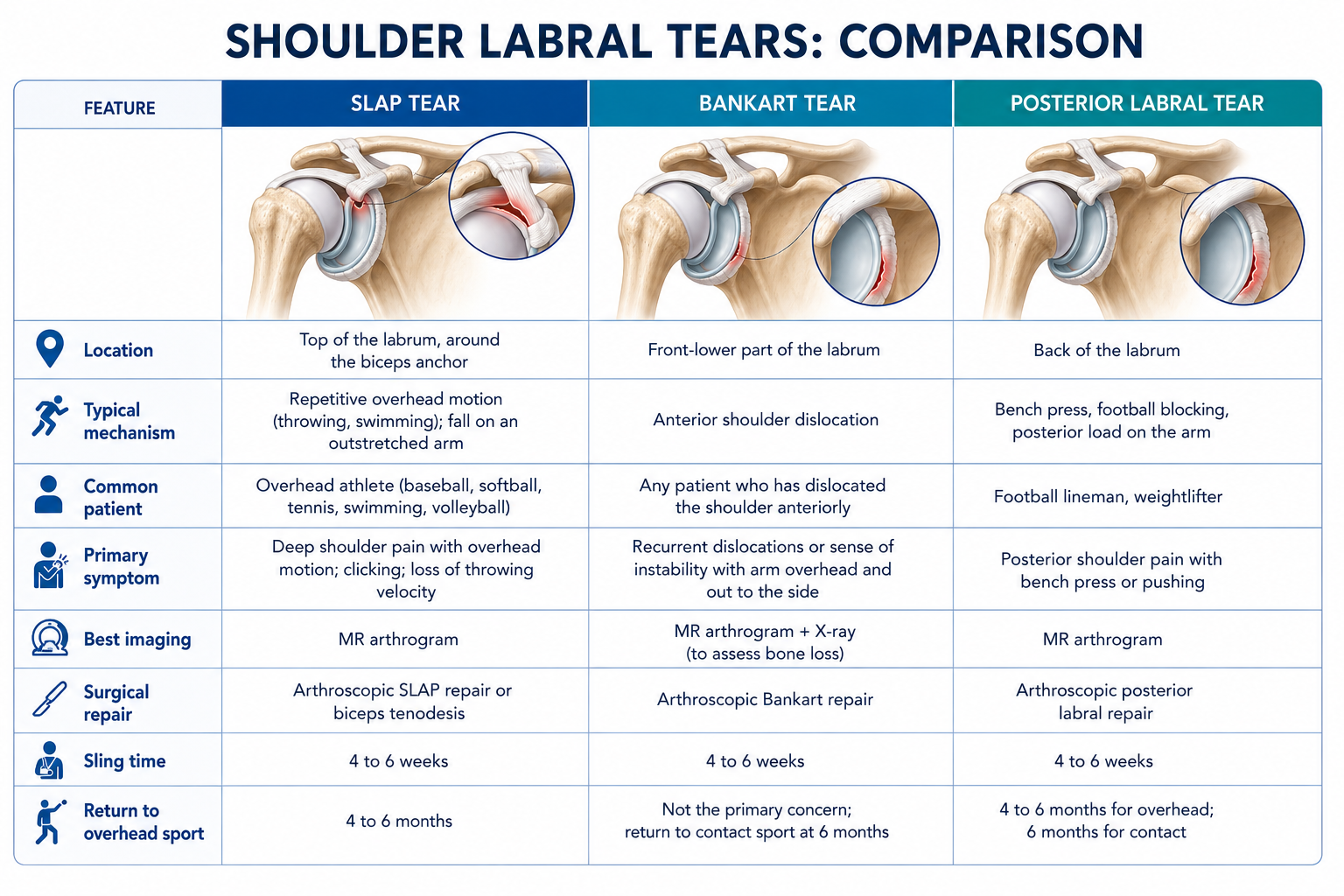
A patient can have more than one type of labral tear at the same time, particularly after a significant trauma. Imaging combined with examination findings identifies the dominant lesion and any associated tears that need to be addressed in the same surgery.
Recovery after shoulder labral repair
Recovery from arthroscopic labral repair happens in distinct phases. The general timeline is similar for SLAP and Bankart repairs, with the main difference being which activities are protected at which stage and when return to sport is appropriate. Specific milestones depend on the tear, the type of repair, the patient's age, and sport or work demands - your surgeon will customize the timeline at each follow-up visit.
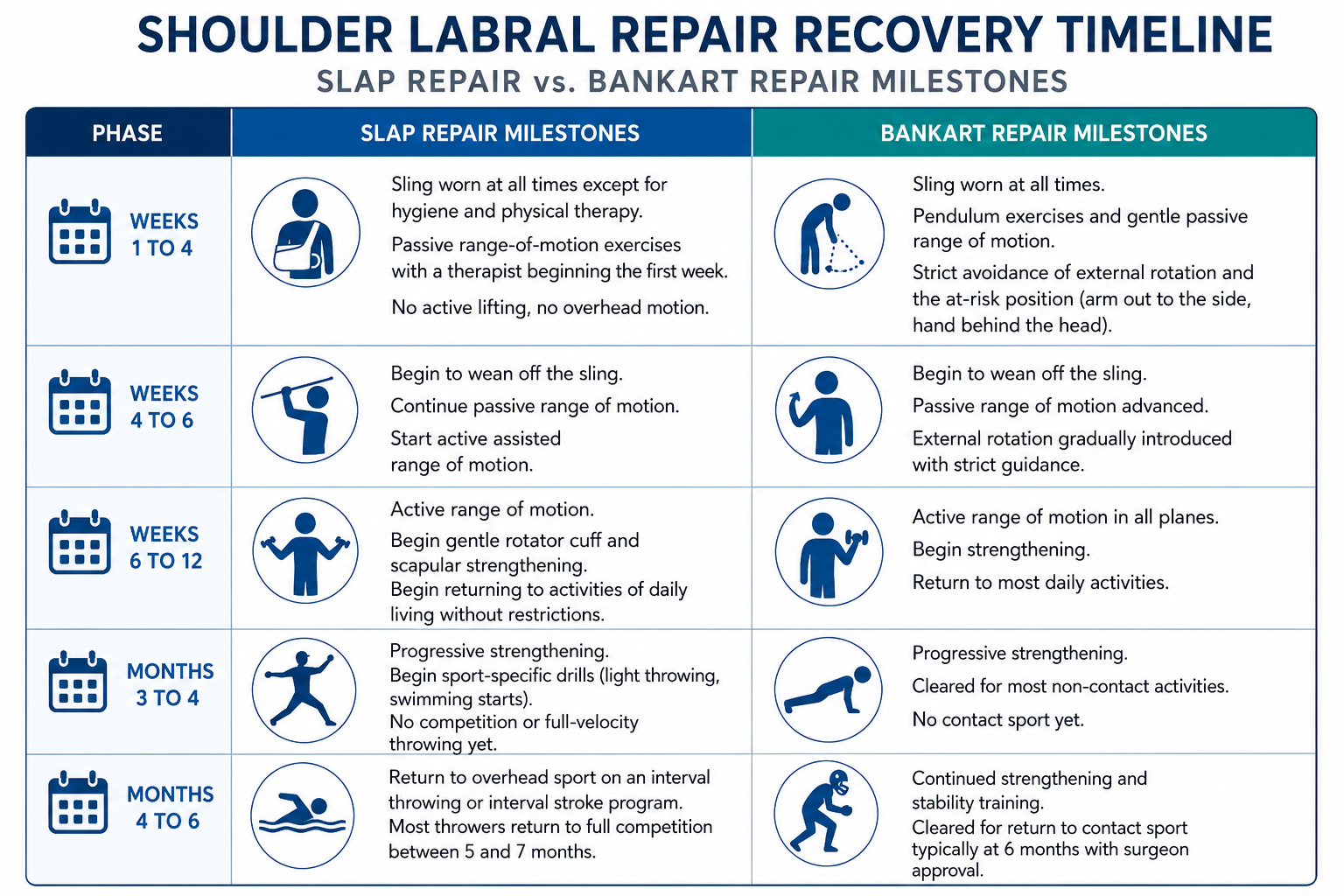
Most patients return to non-strenuous work within 2 to 4 weeks of arthroscopic labral repair. Manual-labor jobs and overhead-work jobs typically require 3 to 6 months before unrestricted return. Aptiva Health's in-house physical therapy team handles labral-repair rehabilitation at our Louisville, Lexington, and Northern Kentucky locations - you do not have to coordinate post-op rehab across a separate practice.
When should you see a doctor for a shoulder labral tear?
Not every shoulder twinge is a labral tear, and not every labral tear requires immediate surgical evaluation. See a shoulder specialist sooner rather than later if you experience any of the following:
Shoulder pain that has lasted more than two to three weeks after an injury or dislocation.
A specific catching, clicking, or popping that reproduces every time you move the arm in a certain way.
A sense that the shoulder is loose or slipping out of place.
Loss of throwing velocity, swimming pace, or overhead lifting strength.
Recurrent shoulder dislocations or subluxations.
Shoulder pain that interferes with sleep, work, or sport.
Weakness in the arm that is not improving with rest.
A first-time anterior shoulder dislocation in a patient under 25 has a very high rate of recurrent dislocation if treated without surgery - which is why early evaluation by a shoulder specialist matters even when the shoulder has gone back into place and pain has settled.
Aptiva Health offers same-day and walk-in shoulder appointments at most locations, plus free 24/7 virtual access to an Aptiva orthopedic provider through the HURT! app - so you do not have to wait weeks to find out whether you have a labral tear.
Why choose Aptiva Health for shoulder labral tear treatment?
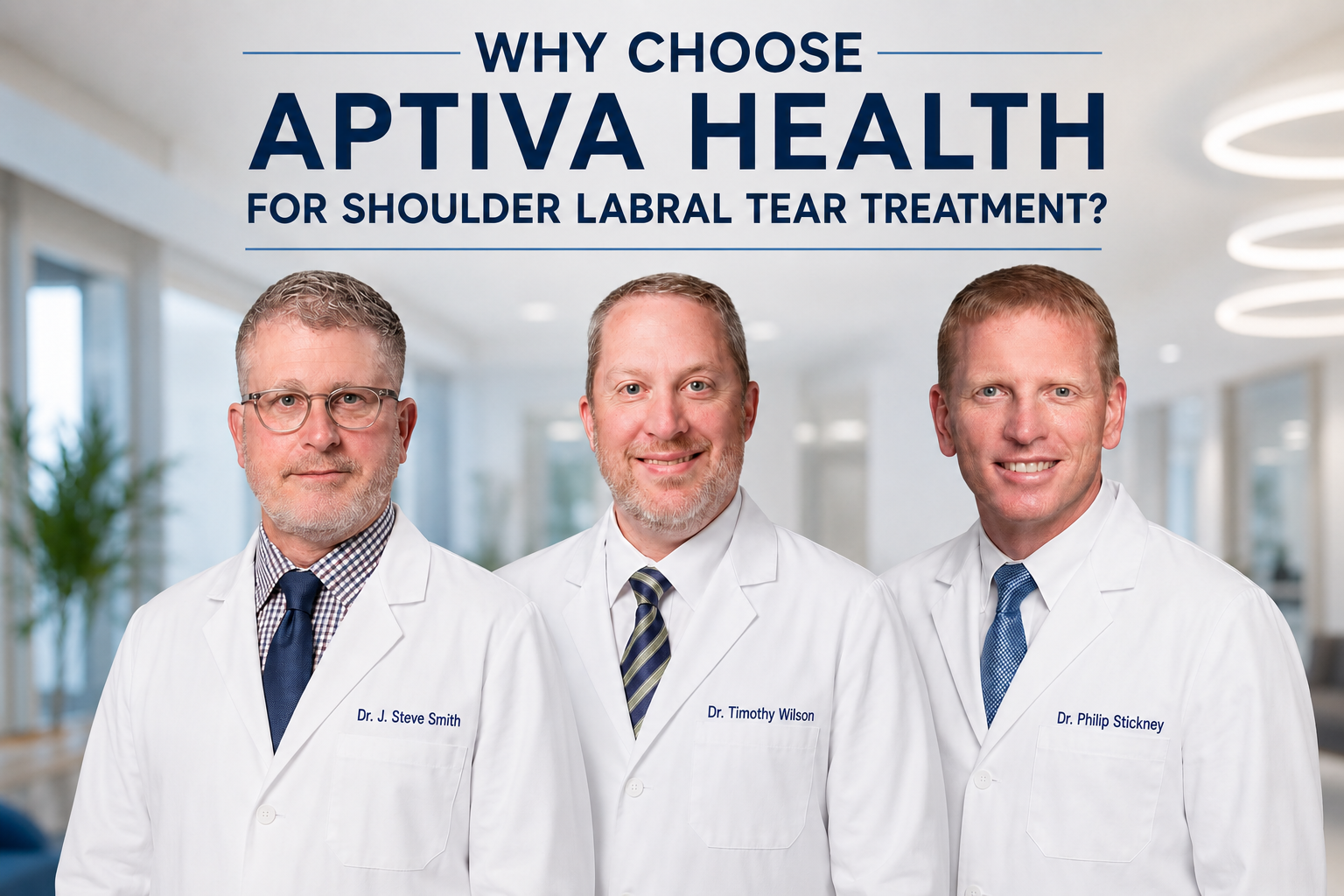
Most patients with a labral tear end up coordinating their care across four or five separate practices: a primary care office for the referral, an orthopedic clinic for the evaluation, an imaging center for the MR arthrogram, a separate physical therapy practice for pre- and post-operative rehab, and possibly a pain clinic for injections. Aptiva Health is built differently. Every step of shoulder labral tear care happens under one roof:
Two fellowship-trained sports medicine shoulder surgeons - Dr. Steve Smith and Dr. Timothy Wilson - both performing arthroscopic SLAP and Bankart repair.
Kerlan-Jobe credentialed surgical authority. Dr. Smith trained at the Kerlan-Jobe Orthopaedic Clinic in Los Angeles - the same program that trains team physicians for the Dodgers, Lakers, and Rams - and brings those techniques to Kentucky and Indiana patients.
On-site MRI at our Louisville, Lexington and northern Kentucky imaging centers.
An interventional pain physician (Dr. Steven Ganzel) on staff for fluoroscopy-guided injections when indicated.
In-house shoulder physical therapy with sport-specific return-to-throwing and return-to-contact protocols.
Same-day and walk-in appointments - no two-month wait for a shoulder consultation.
Free virtual access through the HURT! app for after-hours guidance and triage.
Transparent cash-pay pricing for patients without insurance, plus in-network coverage with Anthem, Aetna, Cigna, Humana, United Healthcare, Medicare, Kentucky Medicaid for orthopedics, VA, and Humana Military.
Schedule your appointment today!
Our Shoulder Surgeons
Aptiva Health's shoulder team is led by two fellowship-trained sports medicine orthopedic surgeons:
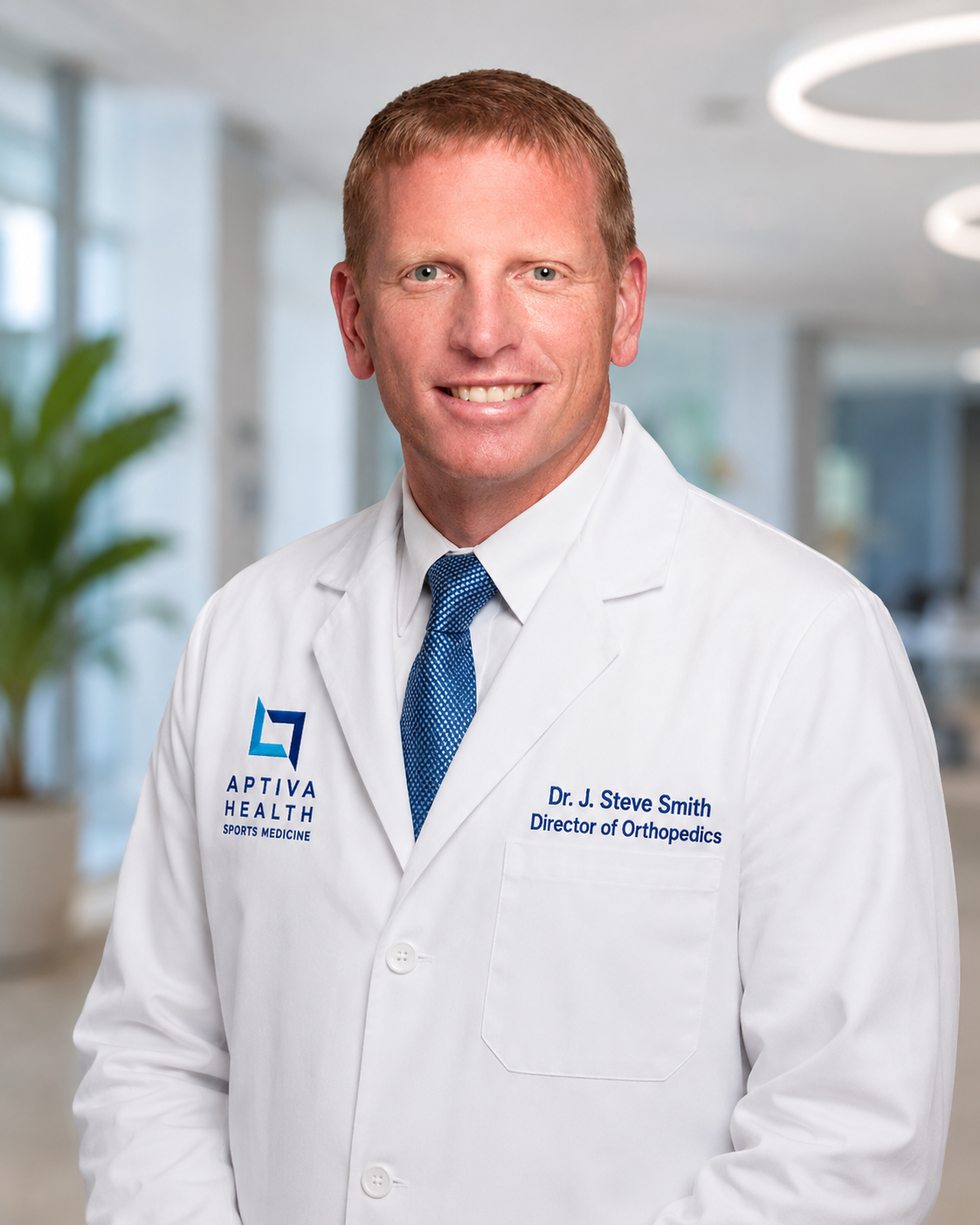
Steve Smith, MD - Director of Orthopedics
Dr. Smith is a sports medicine orthopedic surgeon and the Director of Orthopedics at Aptiva Health. He completed his orthopedic sports medicine fellowship at the Kerlan-Jobe Orthopaedic Clinic in Los Angeles - the program that trains team physicians for the Los Angeles Dodgers, Los Angeles Lakers, and Los Angeles Rams - and served on the medical staff for the Lakers, Dodgers, and Anaheim Ducks. He brings that same level of surgical expertise to overhead athletes and active patients across Kentucky and Indiana. Dr. Smith specializes in arthroscopic shoulder surgery, including SLAP repair, Bankart repair, rotator cuff repair, biceps tenodesis, subacromial decompression, and shoulder stabilization procedures.
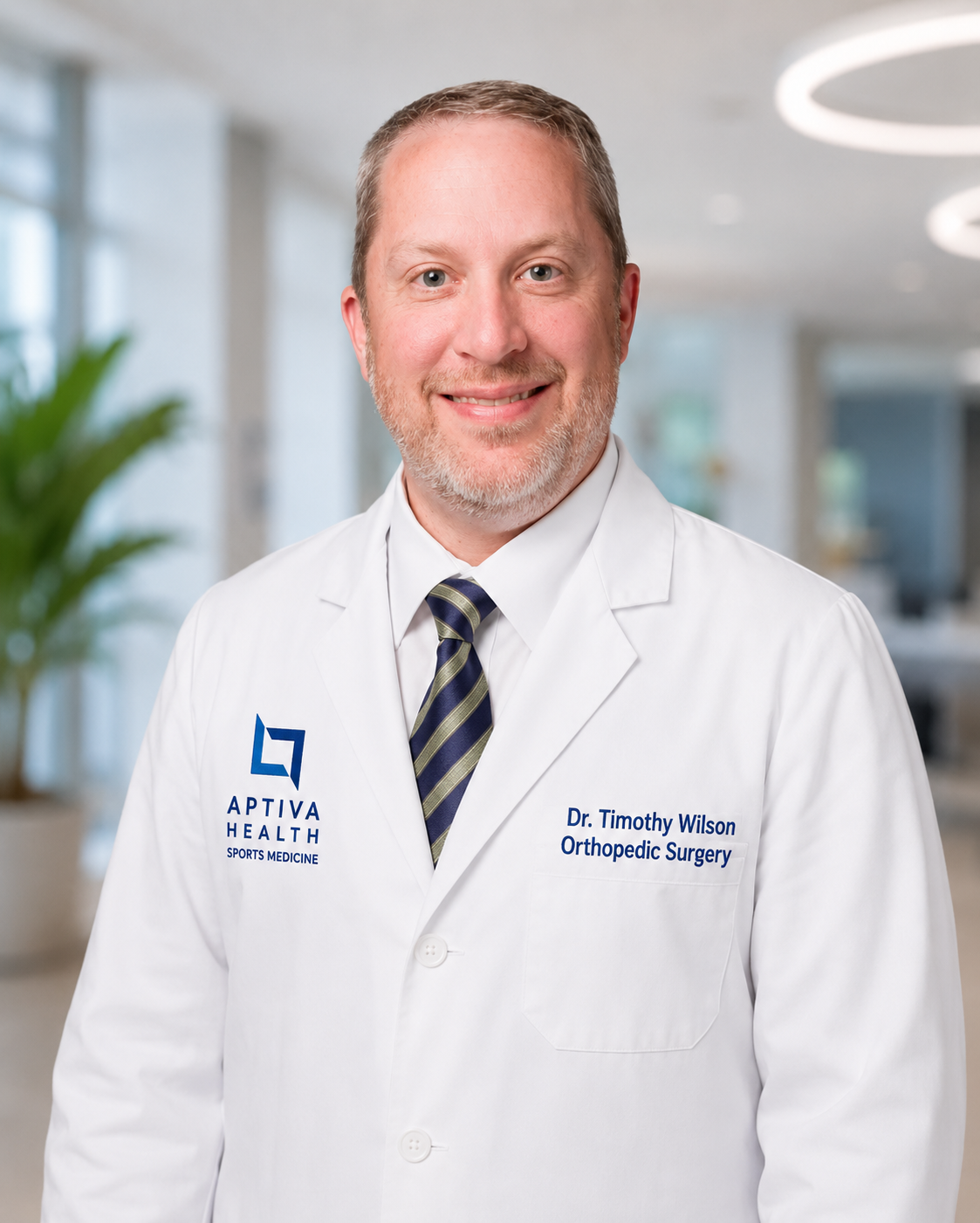
Timothy Wilson, MD - Sports Orthopedic Surgeon
Dr. Wilson is a double board-certified orthopedic surgeon, certified in both Orthopaedic Surgery and Orthopaedic Sports Medicine. He performs the full range of arthroscopic shoulder procedures including SLAP and Bankart repair, rotator cuff repair, and shoulder stabilization. Dr. Wilson sees shoulder patients across multiple Aptiva Health locations.
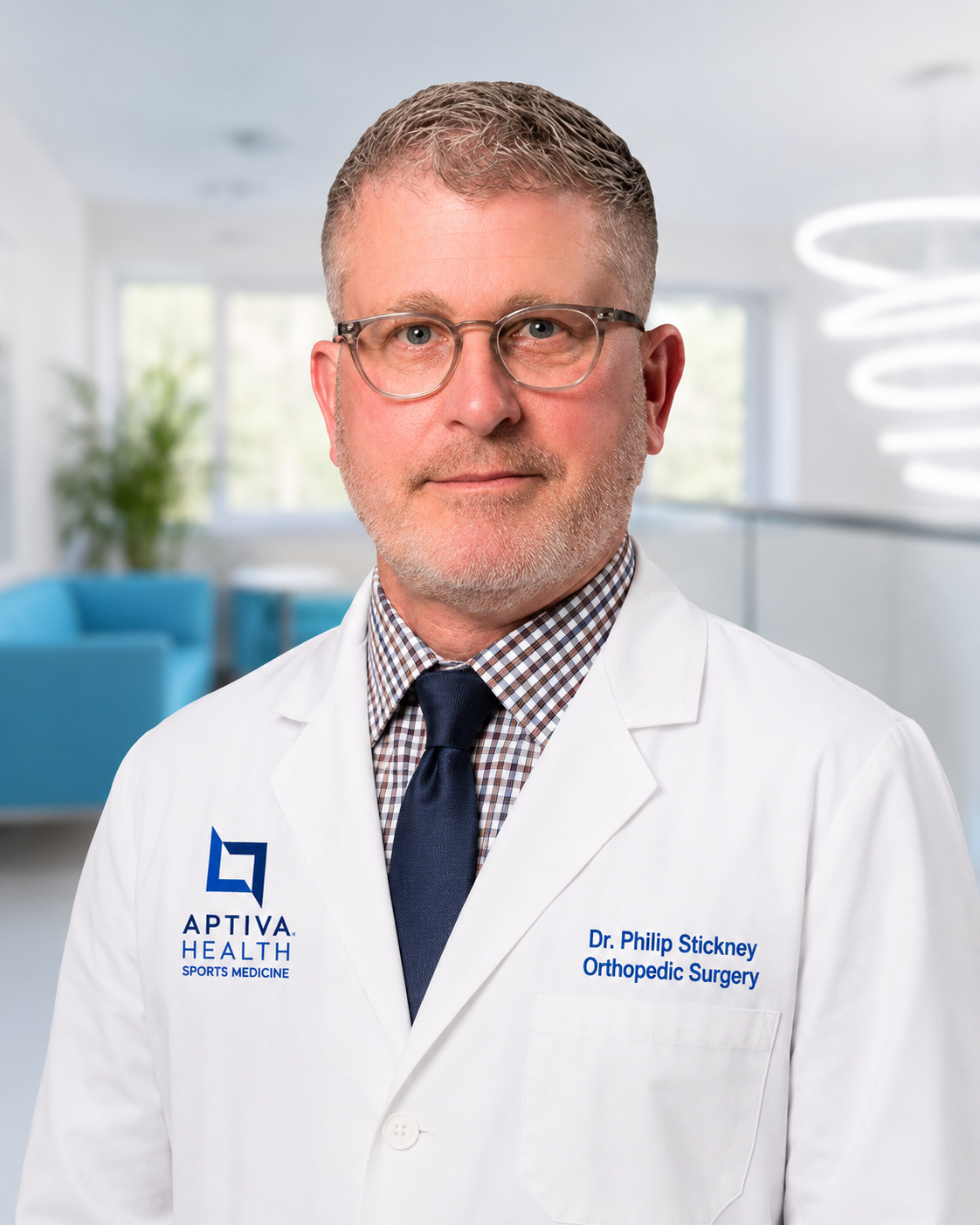
D. Philip Stickney, MD - Orthopedic Surgeon
Dr. Stickney is a board-certified orthopedic surgeon with more than 25 years of clinical experience. He earned his medical degree from Case Western Reserve University in Cleveland with a concentration in emergency medicine, critical care, and trauma, and completed his orthopedic surgery residency at Mt. Sinai Medical Center in Cleveland. His published and presented research spans shoulder, elbow, and fracture care, including peer-reviewed work in the Journal of Shoulder and Elbow Surgery. Dr. Stickney sees patients at Aptiva Health's northern Kentucky and Indianapolis locations.

Locations where we treat shoulder labral tears
Aptiva Health treats shoulder labral tears at locations across Kentucky and Indiana:
Concussion & Sports Medicine Institute - 3611 Newburg Road, Louisville, KY 40218. Tel: 502-909-0772
Louisville East - 10100 Linn Station Road, Suite 1A, Louisville, KY 40223. Tel: 502-909-0772
Louisville Downtown: 300 S 13th Street, Louisville, KY 40203. Tel: 502-583-1011.
Louisville Middletown: 401 N English Station Road, Suite 1A, Louisville, KY 40223. Tel: 502-909-0772.
Lexington: 230 Fountain Court, Suite 180, Lexington, KY 40509. Tel: 859-592-1008.
Lexington Physical Therapy - 152 W. Tiverton Way, Ste. 180, Lexington, KY 40503. Tel: 859-592-1008
Northern Kentucky - 2093 Medical Arts Drive, Hebron, KY 41048. (serving the greater Cincinnati metro). Tel: 859-592-1008
Elizabethtown - 529 Westport Road, Suite 2, Elizabethtown, KY 42701. Tel: 270-506-4888
Mt. Washington - 737 N. Mt. Washington Bypass Road, Suite 101, Mt. Washington, KY 40047. Tel: 502-909-0772.
Indianapolis - 6801 Gray Road, Indianapolis, IN 46237. Tel: 463-303-0501. (opening April 2026; now scheduling appointments)
Frequently asked questions about shoulder labral tears
What is a shoulder labral tear?
The labrum is a ring of cartilage that surrounds the shoulder socket (glenoid) and deepens it, helping hold the ball of the upper arm bone in place. A shoulder labral tear is a tear in that ring of cartilage. The most common types are SLAP tears (Superior Labrum Anterior-Posterior), which occur at the top of the labrum where the biceps tendon attaches, and Bankart tears, which occur at the front-lower portion of the labrum after a shoulder dislocation.
What does a shoulder labral tear feel like?
Common symptoms include deep shoulder pain (often described as catching or clicking with arm motion), a sense that the shoulder is slipping or unstable, weakness with overhead activity, pain reaching behind the back, decreased range of motion, and popping or grinding in the joint. Symptoms typically worsen with overhead activities like throwing, swimming, lifting, or racquet sports.
How is a shoulder labral tear diagnosed?
Diagnosis combines a focused medical history, a physical examination using specific provocative tests (such as the O'Brien test, anterior apprehension test, and Speed test), and imaging. Standard MRI shows many but not all labral tears; MR arthrogram (MRI with contrast injected into the joint) is the gold-standard imaging study because it outlines the labrum more clearly. Aptiva Health offers on-site MRI at our Louisville and Lexington imaging centers, with most patients imaged within the same week as their first visit.
Can a shoulder labral tear heal without surgery?
Many shoulder labral tears, especially small or partial tears, improve significantly with conservative treatment: structured physical therapy focused on rotator cuff and scapular stabilizer strengthening, activity modification, anti-inflammatory medication, and (in some cases) a corticosteroid injection. Surgery is typically reserved for athletes returning to overhead sport, patients with recurrent instability, and tears that have not responded to several months of conservative care.
What is the difference between a SLAP tear and a Bankart tear?
A SLAP tear (Superior Labrum Anterior-Posterior) occurs at the top of the labrum where the long head of the biceps tendon attaches. SLAP tears are most common in overhead athletes (throwers, swimmers, racquet sport players) and after falls onto an outstretched arm. A Bankart tear occurs at the front-lower part of the labrum and is the classic injury following an anterior shoulder dislocation. The two tears have different surgical approaches and different recovery timelines.
What is SLAP repair surgery?
Arthroscopic SLAP repair is a minimally invasive surgery performed through three to four small incisions around the shoulder. A camera and specialized instruments are inserted into the joint; the torn portion of the superior labrum is either debrided or reattached to the bone using bioabsorbable suture anchors. The procedure is performed as outpatient surgery; most patients return home the same day. Aptiva Health's fellowship-trained orthopedic surgeons perform SLAP repair using techniques developed at the Kerlan-Jobe Orthopaedic Clinic, the program that trains team physicians for the Los Angeles Dodgers, Los Angeles Lakers, and Los Angeles Rams, among other professional teams.
What is Bankart repair surgery?
Arthroscopic Bankart repair is a minimally invasive surgery for anterior shoulder instability following a dislocation. The torn anterior-inferior labrum is reattached to the glenoid rim using suture anchors, restoring the labrum's stabilizing function and tightening the capsule to prevent recurrent dislocation. The procedure is performed as outpatient surgery. Recurrent dislocations are significantly less likely after a properly performed Bankart repair compared with non-surgical treatment alone.
How long is recovery from shoulder labral repair?
Recovery happens in stages. Weeks 1 to 6: sling worn most of the time, with passive range of motion physical therapy beginning in the first week. Weeks 6 to 12: progressive active range of motion and early strengthening. Months 3 to 4: return to most non-contact activities. Months 4 to 6: return to overhead sports for SLAP repair patients; contact sport return typically 6 months for Bankart repair patients. Specific timelines depend on the tear, the type of repair, and the patient's sport or work demands.
Do I need an MRI for a labral tear?
MRI or MR arthrogram is typically ordered when a labral tear is suspected after history and physical examination. Aptiva Health offers on-site MRI at our Louisville, Lexington and Northern Kentucky imaging centers, and most patients are imaged within the same week as their first visit.
Is shoulder labral tear treatment covered by insurance?
Yes. Evaluation, MRI imaging, physical therapy, injections, and arthroscopic labral repair are covered by most commercial insurance plans, Medicare, and Kentucky Medicaid for orthopedics. Aptiva Health is in-network with Anthem, Aetna, Cigna, Humana, United Healthcare, Medicare, Kentucky Medicaid for orthopedics, VA, and Humana Military, and offers transparent cash-pay pricing for patients without insurance.
Who performs shoulder labral repair at Aptiva Health?
Aptiva Health's fellowship-trained orthopedic surgeons perform arthroscopic SLAP and Bankart repair, including Dr. Steve Smith, who completed his orthopedic sports medicine fellowship at the Kerlan-Jobe Orthopaedic Clinic in Los Angeles - the program that trains team physicians for the Los Angeles Dodgers, Los Angeles Lakers, and Los Angeles Rams - and Dr. Timothy Wilson, who is double board-certified in Orthopaedic Surgery and Orthopaedic Sports Medicine. Aptiva also offers in-house imaging and physical therapy, so evaluation, diagnosis, surgery, and rehabilitation all happen under one roof.
How quickly can I be seen for a shoulder labral tear at Aptiva Health?
Aptiva Health offers same-day and walk-in orthopedic appointments at most locations across Louisville, Lexington, Northern Kentucky, Elizabethtown, and Mt. Washington, with most patients evaluated within 24 hours of contacting us. The HURT! app provides free, 24/7 virtual access to an orthopedic provider for after-hours guidance. No primary care referral is required.
Stop guessing what is causing your shoulder pain. Aptiva Health's fellowship-trained shoulder surgeons can evaluate your symptoms, image the source of the pain with on-site MRI and start treatment - often within the same week.