Direct Healthcare Contracting
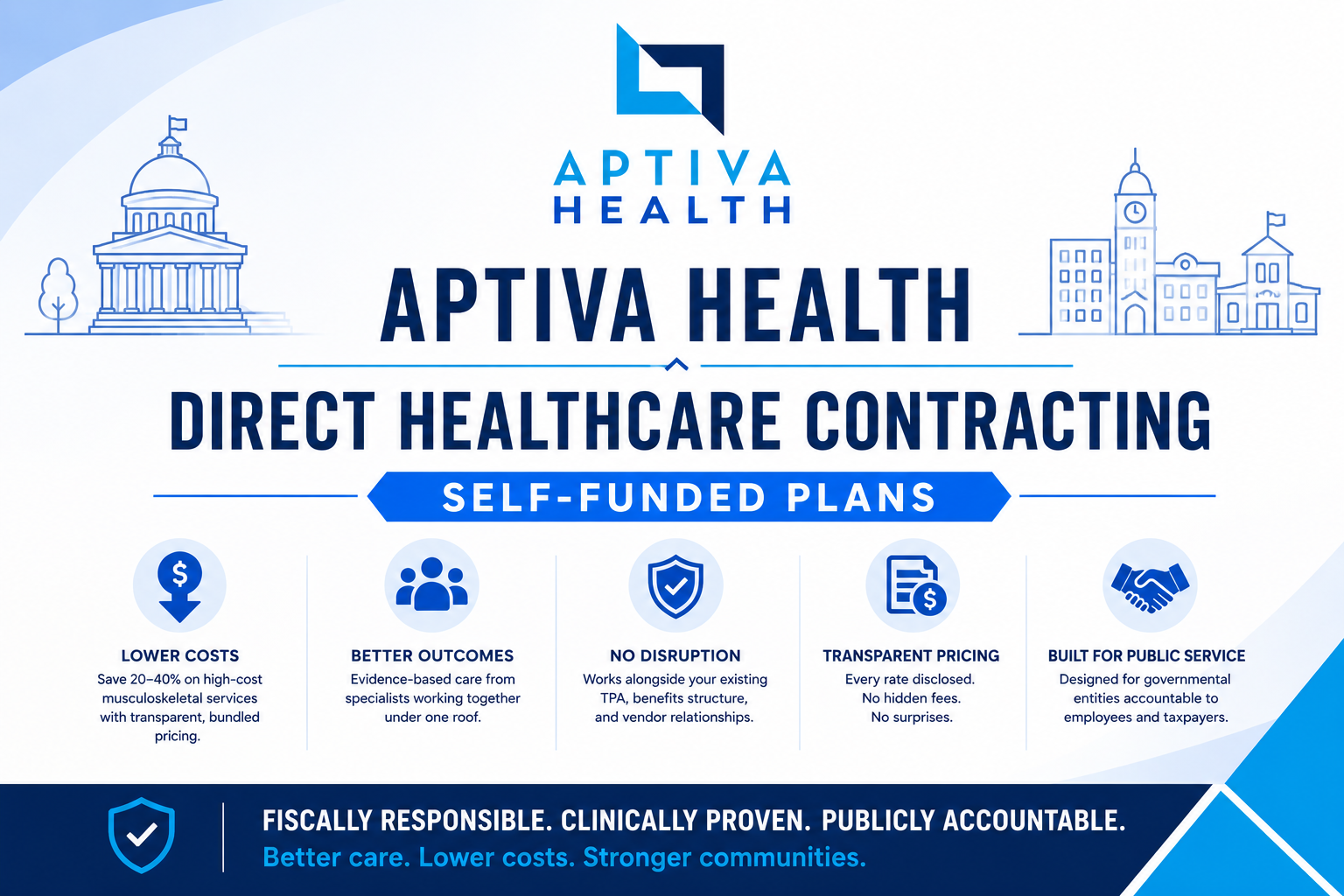
Bundled, transparent rates for orthopedic, spine, MRI, PT, and pain care — typically cutting high-cost surgical claims 50–70% for self-funded plans across Kentucky and Indiana.
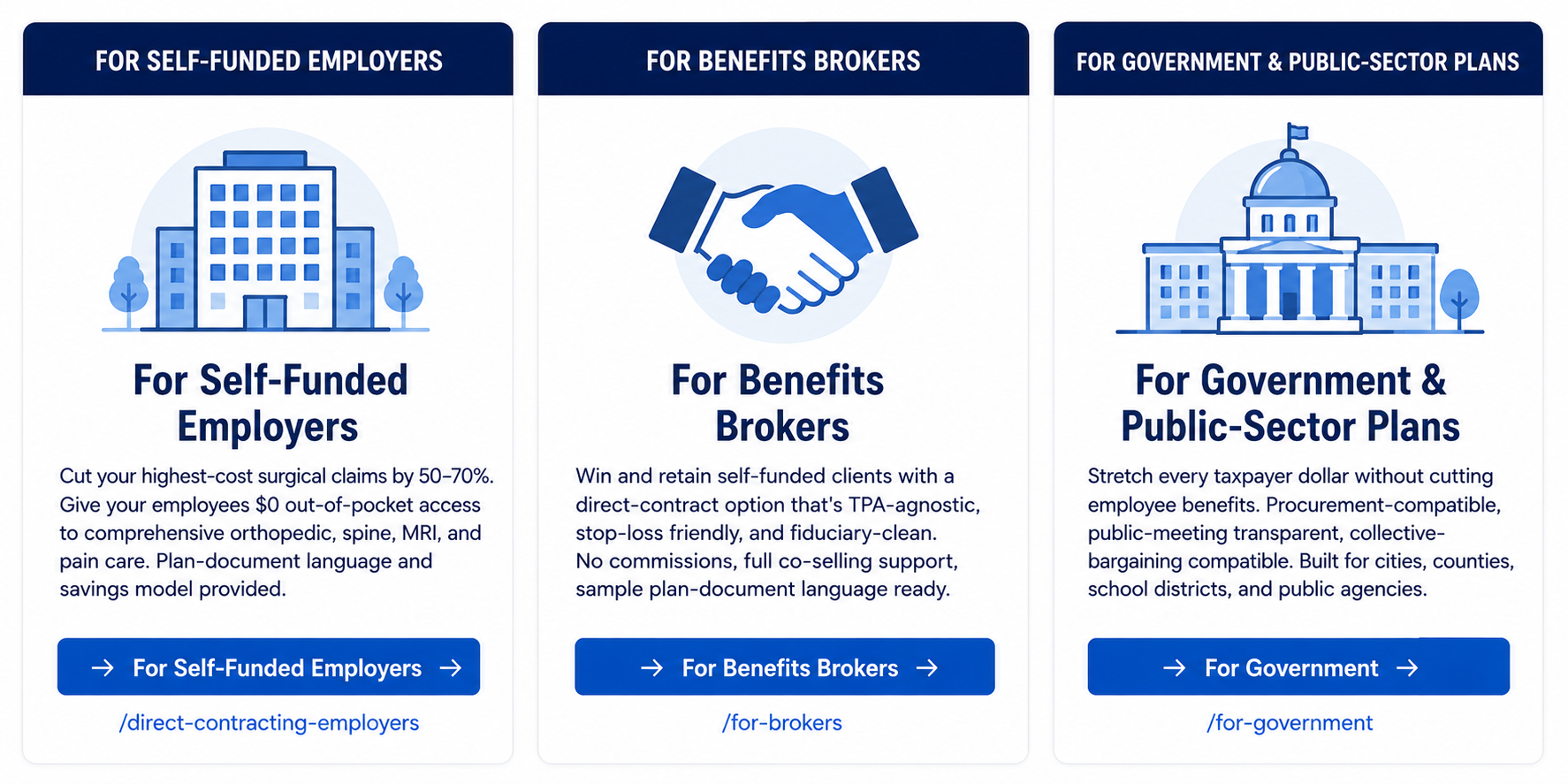
One Program. Three Doors In.
Aptiva Health's direct contracting program is one model — a Direct Medical Services Agreement with bundled, transparent rates — designed to work through three distinct paths into a self-funded plan. Whether you're the employer running the plan, the broker advising the plan, or the public-sector administrator accountable for the plan, the underlying contract structure, savings methodology, and member experience are the same. Pick the path that fits how you'll engage.
How Direct Contracting Works
Traditional PPO networks apply a discount to a hospital's chargemaster price, then bill the plan and the patient through standard fee-for-service mechanics. Surgeon, facility, anesthesia, and ancillary services typically arrive as separate claims with separate repricing. The plan sponsor sees variability, the patient sees surprise bills, and the broker sees a renewal that's hard to defend.
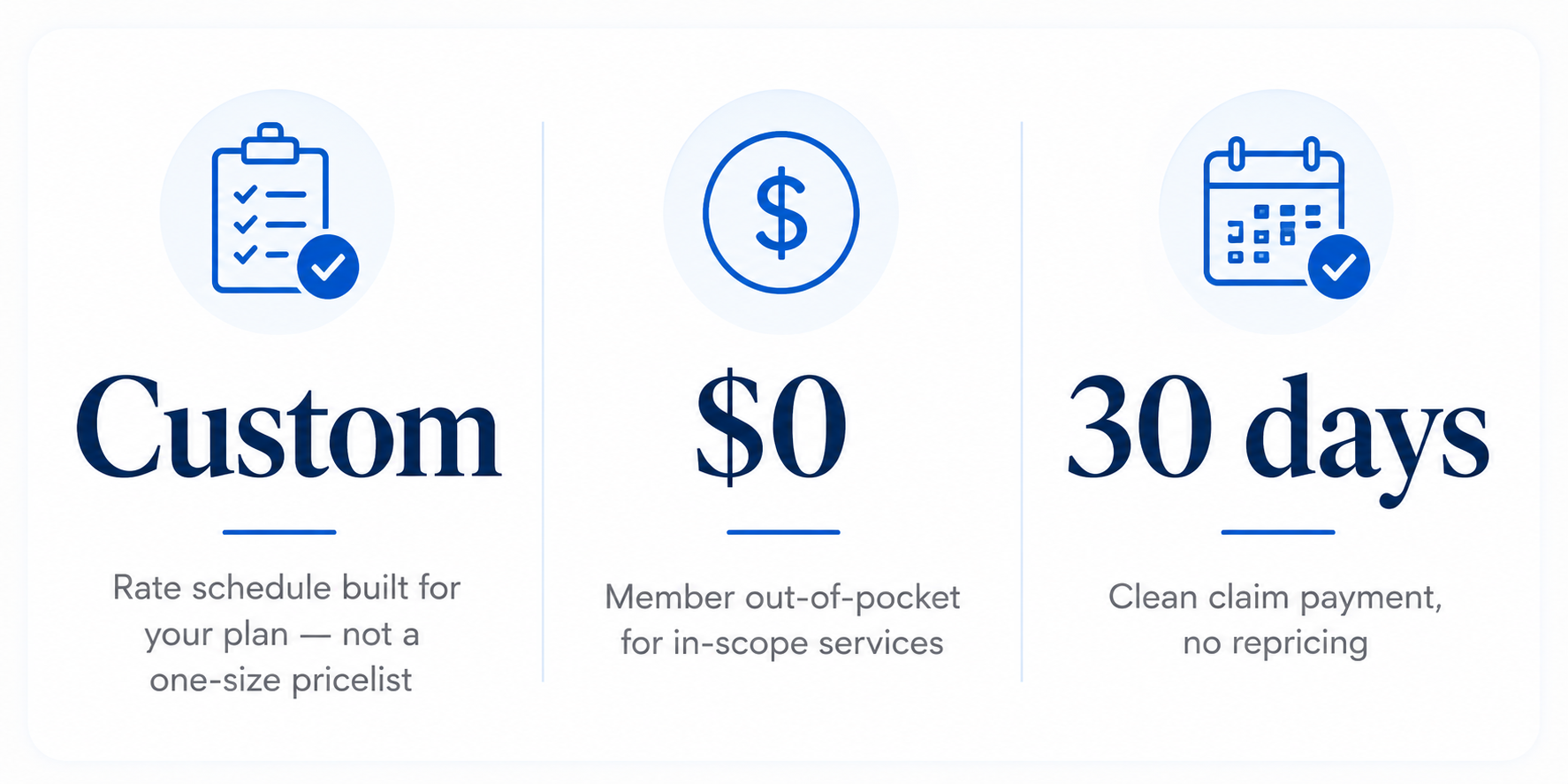
A direct contract replaces that entire structure for in-scope services. The plan and Aptiva agree to a single bundled rate per episode of care, negotiated and documented before any patient is seen. There is no facility fee. There is no anesthesia surprise bill. There is no chargemaster. The plan pays one rate, the patient pays nothing for in-scope services, and Aptiva receives the full negotiated amount within 30 days of clean claim submission. The savings show up on the plan's monthly claims report. The rate exhibit is transparent enough to print in a board packet or a renewal presentation.
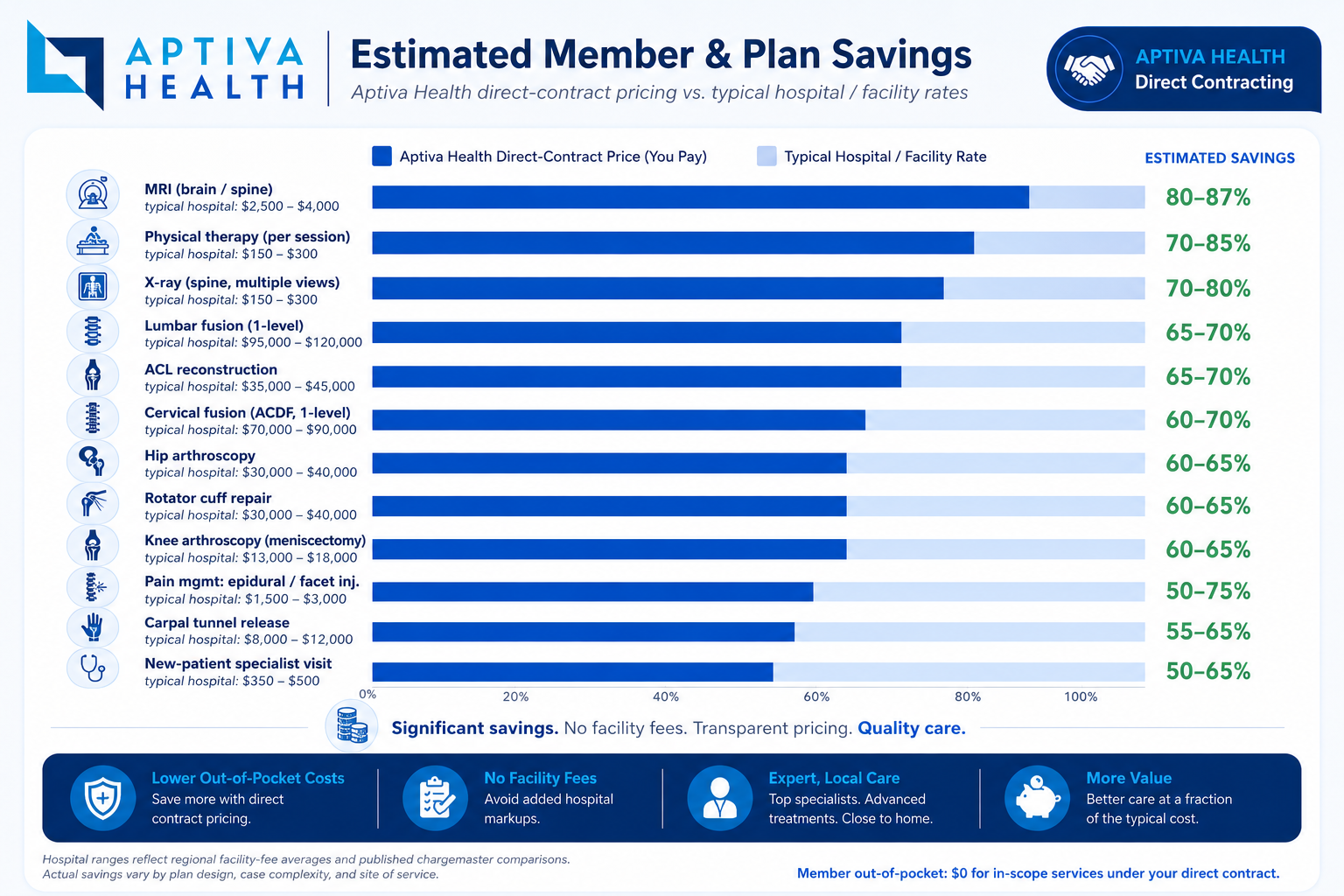
What Direct Contracting Typically Saves
Hospital ranges reflect regional facility-fee averages and published chargemaster comparisons. Savings ranges shown are illustrative of outcomes seen across our current direct-contract partners; your actual savings will depend on your negotiated rate schedule, plan design, and case mix. Each Aptiva direct contract is custom-built for the plan it covers.
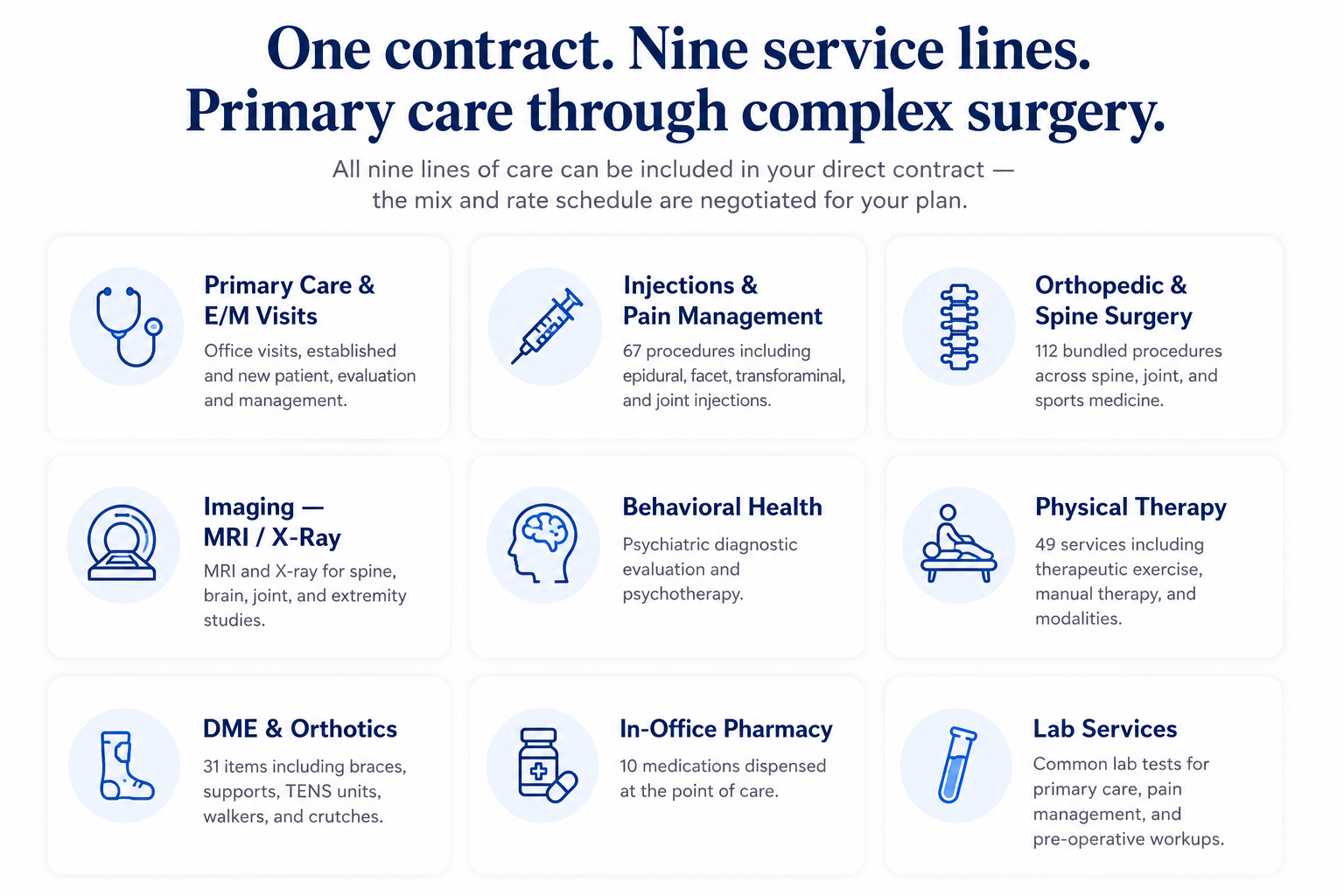
In-Scope Service Lines
A direct contract gives the plan access to Aptiva Health's full multi-specialty footprint across Kentucky and Indiana. In-scope service lines include:
Orthopedic Surgery — total joint replacement, sports medicine procedures, fracture care, hand and foot.
Spine Care — ACDF, cervical disc replacement, microdiscectomy, SI joint fusion, minimally invasive fusion.
Interventional Pain Management — epidural steroid injections, radiofrequency ablation, joint injections.
MRI & Diagnostic Imaging — MRI in Louisville, Lexington, and Northern Kentucky with digital x-ray at each clinic location.
Physical Therapy — direct-access PT, one-on-one treatment time.
Sports Medicine — non-operative and operative care, return-to-play and return-to-work pathways.
Concussion Care — led by Dr. Lisa Manderino at the Aptiva Concussion & Sports Medicine Institute.
Immediate Injury Care — same-day evaluation for sprains, strains, fractures, and lacerations.
Geography: 14 locations across Louisville, Lexington, Elizabethtown, Mt. Washington, Hebron (Northern KY / Greater Cincinnati), and Indianapolis. See all locations →
Excluded from direct contract scope: Workers' compensation claims and auto / PIP injury claims. The same Aptiva practitioner coordinates care across all three claim types so member experience remains consistent.
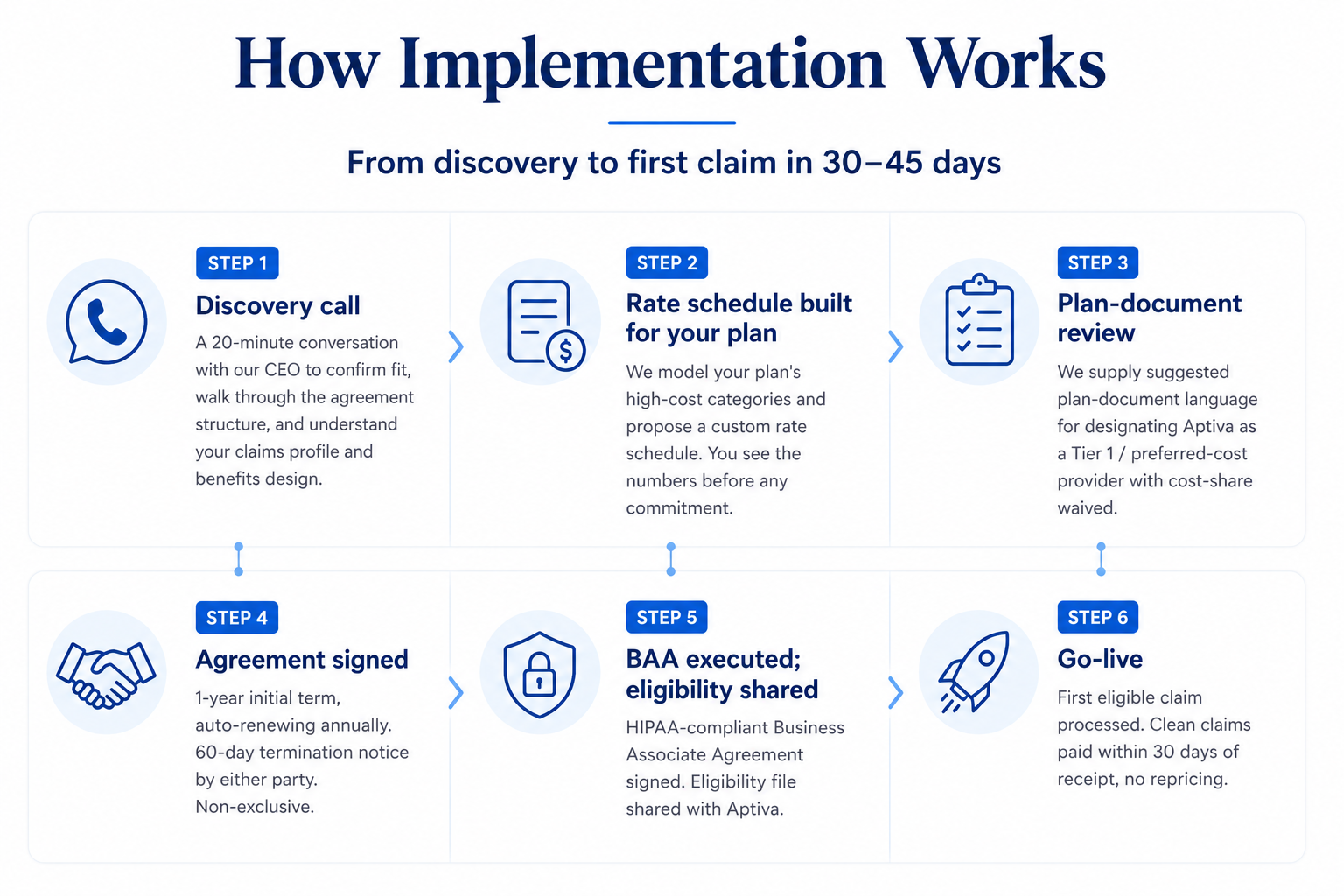
Implementation Timeline
Step 1 · Discovery Call (Week 1) 20-minute call to align on plan structure, current claims profile, and direct-contract fit. No NDA required for this conversation.
Step 2 · Savings Model & Rate Exhibit (Weeks 2–4) Aptiva builds a custom savings model from anonymized claims data and provides a full rate exhibit for plan-sponsor review. Plan-document language is supplied.
Step 3 · Agreement & BAA Execution (Weeks 4–6) Direct Medical Services Agreement and Business Associate Agreement are signed. Eligibility file format is finalized with the TPA.
Step 4 · Go-Live (Weeks 6–8) First eligible claim accepted. Quarterly savings reporting begins. Plan sponsor receives ongoing documentation suitable for renewal presentations, public-meeting disclosure, or stop-loss disclosure as applicable to the audience.
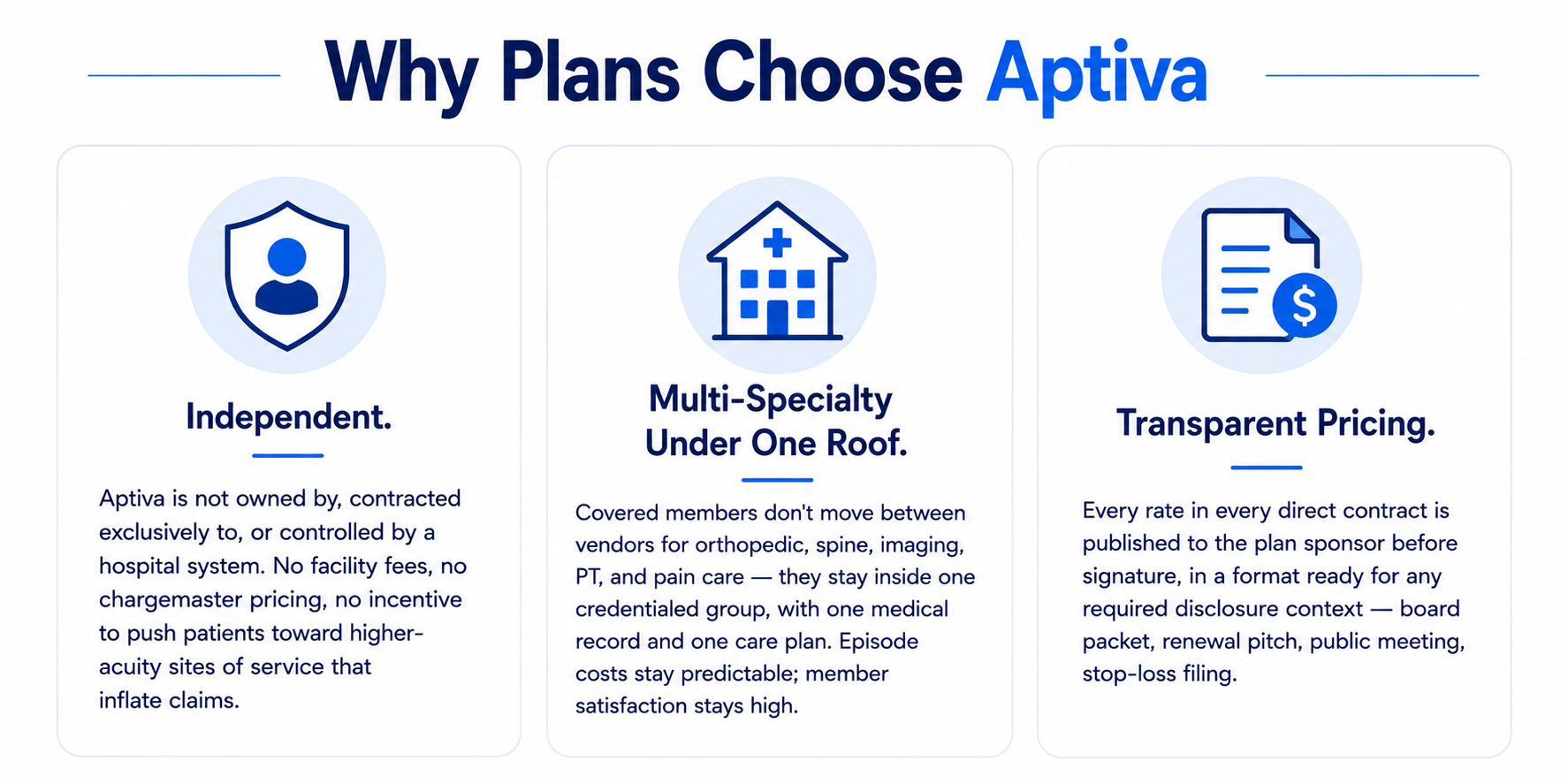
Why Plans Choose Aptiva
Independent. Aptiva is not owned by, contracted exclusively to, or controlled by a hospital system. No facility fees, no chargemaster pricing, no incentive to push patients toward higher-acuity sites of service that inflate claims.
Multi-Specialty Under One Roof. Covered members don't move between vendors for orthopedic, spine, imaging, PT, and pain care — they stay inside one credentialed group, with one medical record and one care plan. Episode costs stay predictable; member satisfaction stays high.
Transparent Pricing. Every rate in every direct contract is published to the plan sponsor before signature, in a format ready for any required disclosure context — board packet, renewal pitch, public meeting, stop-loss filing.
Frequently Asked Questions
What is direct healthcare contracting?
Direct healthcare contracting is a payment arrangement in which a self-funded employer plan contracts directly with a healthcare provider — bypassing the traditional PPO network repricing chain — to receive a bundled, transparent rate for defined services. The plan pays the provider a fixed rate per episode of care, with no facility fees, no chargemaster pricing, and no repricing applied to clean claims. Patients typically pay $0 out-of-pocket for in-scope services because the cost share is waived at the plan-design level. Aptiva Health direct contracts cover orthopedic surgery, spine surgery, MRI imaging, physical therapy, interventional pain management, and related outpatient services.
How is direct contracting different from a PPO network?
A PPO network applies a discount to a hospital's chargemaster price, then bills the plan and the patient through standard fee-for-service mechanics — surgeon, facility, anesthesia, and ancillary services typically arrive as separate claims with separate repricing. A direct contract replaces that entire structure for in-scope services with a single bundled rate negotiated between the plan and the provider. There is no facility fee. There is no anesthesia surprise bill. There is no chargemaster. The plan pays one rate, the patient pays nothing, and the provider receives the full negotiated amount within 30 days of clean claim submission.
Who does Aptiva Health offer direct contracts to?
Aptiva Health offers direct contracts to three primary audiences: self-funded employer plans across any industry; benefits brokers and consultants representing self-funded employer clients; and government and public-sector plans including cities, counties, school districts, public universities, and special districts. All three audiences contract under the same Direct Medical Services Agreement framework, with rate exhibits customized per plan.
What services are covered under an Aptiva direct contract?
Aptiva direct contracts cover the full multi-specialty footprint: orthopedic surgery, spine surgery, interventional pain management, MRI and diagnostic imaging, physical therapy, sports medicine, concussion care, and immediate injury care. Workers' compensation claims and auto/PIP injury claims are explicitly excluded from direct contract scope and managed under separate Aptiva pathways, though the same practitioner coordinates care across all three claim types.
How much does direct contracting typically save a plan?
Direct-contract savings on high-cost surgical and orthopedic claims typically run 50% to 70% versus hospital-based equivalents for the same procedures. The savings range depends on the negotiated rate schedule, the plan's existing PPO discounts, plan design, and case mix. Aptiva builds a custom savings model from anonymized claims data before any contract is signed, so the projected savings are documented and defensible before the plan sponsor commits.
How long does direct contract implementation take?
Typical implementation runs 30 to 45 days from agreement signature to first eligible claim. The sequence is: discovery call, plan-document review, agreement signature, BAA execution, eligibility file share, go-live. From the first introductory conversation to first eligible claim, the full cycle is usually 60 to 90 days. Implementation works with calendar-year and fiscal-year plan cycles.
Does Aptiva direct contracting replace our existing health plan?
No. Aptiva direct contracts are non-exclusive and additive — they sit alongside the plan's existing PPO networks and other vendor relationships. The plan document designates Aptiva as a Tier 1 / preferred-cost-share option for in-scope services, while every other vendor and network relationship remains in place. Plan sponsors can adopt direct contracting incrementally without restructuring the entire benefit.
Is direct contracting legal and compliant under ERISA?
Yes. Direct contracting between a self-funded plan and a healthcare provider is a well-established structure under ERISA and is increasingly common as plan sponsors respond to fiduciary obligations under the Consolidated Appropriations Act (CAA). Because direct contracts deliver transparent, disclosed pricing rather than opaque network repricing, they are generally considered well-aligned with the prudent-fee and fee-disclosure obligations that apply to plan fiduciaries. Aptiva supplies plan-sponsor counsel with the documentation needed to confirm compliance before signature.
Start the Conversation
Whichever path fits — employer, broker, or government — the first step is a 20-minute discovery call. No NDA required.