

Shoulder Labrum Repair in Northern Kentucky
Aptiva Health provides comprehensive shoulder labrum care in Northern Kentucky — from the first evaluation through imaging, conservative treatment, surgery, and rehabilitation — anchored by board-certified orthopedic surgeons and a team of orthopedic advanced practice providers. We treat every type of labral tear, including SLAP and Bankart tears, prioritizing conservative care first and offering minimally invasive arthroscopic labral repair when surgery becomes the right answer. With on-site MRI, on-site physical therapy, and an in-house orthopedic and sports medicine team, the entire shoulder care pathway happens under one roof.
Medically reviewed by D. Philip Stickney, MD, August 2026.
Schedule your appointment today!

What Is the Shoulder Labrum?
The shoulder is a ball-and-socket joint, but the socket — the glenoid — is shallow, more like a saucer than a cup. The labrum is a rim of cartilage that lines the edge of that socket and deepens it.
The labrum does several jobs at once. It deepens the socket so the ball of the upper arm bone stays centered, it adds stability to a joint that is built for mobility, and it serves as the anchor point for the biceps tendon and several of the shoulder ligaments.
A labral tear is a tear in this cartilage rim. Because the labrum is involved in both stability and the attachment of the biceps and ligaments, a tear can make the shoulder painful, unstable, or both — depending on where in the labrum the tear occurs.
SLAP tears
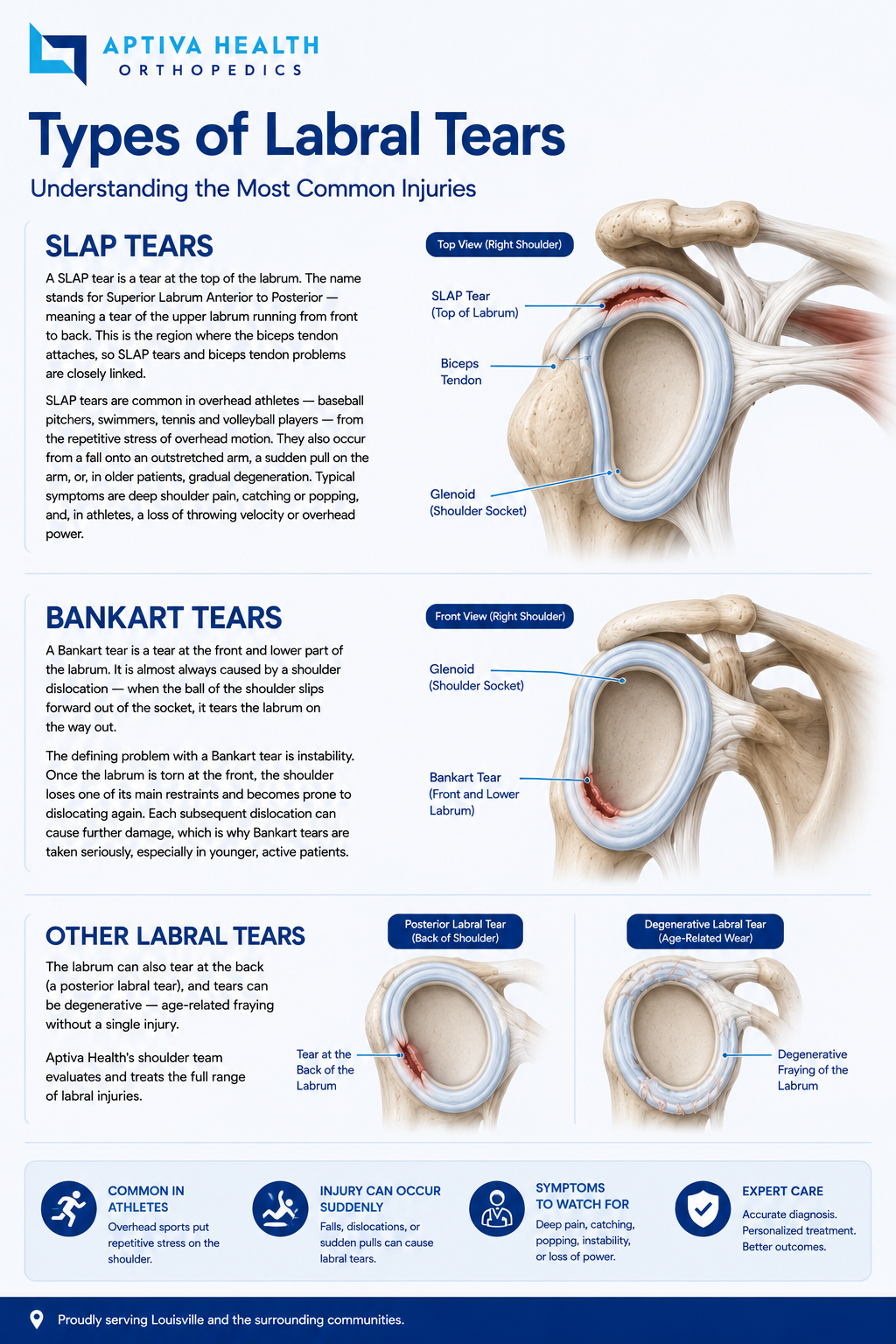
A SLAP tear is a tear at the top of the labrum. The name stands for Superior Labrum Anterior to Posterior — meaning a tear of the upper labrum running from front to back. This is the region where the biceps tendon attaches, so SLAP tears and biceps tendon problems are closely linked.
SLAP tears are common in overhead athletes — baseball pitchers, swimmers, tennis and volleyball players — from the repetitive stress of overhead motion. They also occur from a fall onto an outstretched arm, a sudden pull on the arm, or, in older patients, gradual degeneration. Typical symptoms are deep shoulder pain, catching or popping, and, in athletes, a loss of throwing velocity or overhead power.
Bankart tears
A Bankart tear is a tear at the front and lower part of the labrum. It is almost always caused by a shoulder dislocation — when the ball of the shoulder slips forward out of the socket, it tears the labrum on the way out.
The defining problem with a Bankart tear is instability. Once the labrum is torn at the front, the shoulder loses one of its main restraints and becomes prone to dislocating again. Each subsequent dislocation can cause further damage, which is why Bankart tears are taken seriously, especially in younger, active patients.
Other labral tears
The labrum can also tear at the back (a posterior labral tear), and tears can be degenerative — age-related fraying without a single injury. Aptiva Health's shoulder team evaluates and treats the full range of labral injuries.

Symptoms of a Torn Labrum
Labral tear symptoms depend on the tear's location, but commonly include:
Deep shoulder pain — often described as a pain felt inside the joint, frequently worse with overhead activity.
Catching, locking, or popping — a mechanical clicking or grinding as the shoulder moves.
A loose or unstable shoulder — a sense that the shoulder slips, shifts, or could come out of place, most pronounced with a Bankart tear.
Recurrent dislocation or subluxation — the shoulder fully or partially dislocating, the hallmark of instability from a Bankart tear.
Weakness and loss of motion — reduced shoulder strength and a sense the shoulder is not reliable.
Loss of overhead power — for athletes, a drop in throwing velocity or overhead performance, common with SLAP tears.
How a Labral Tear Happens
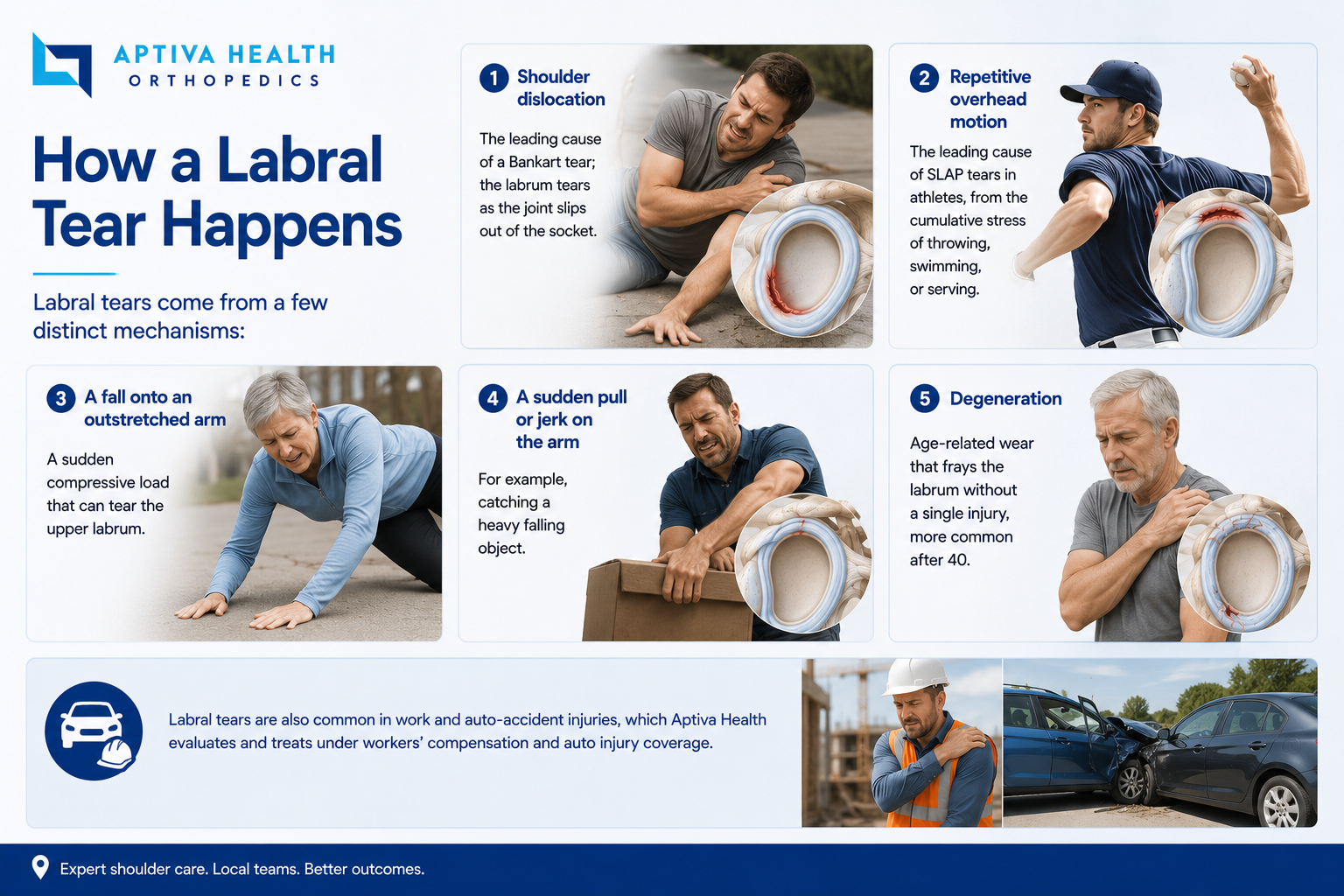
Labral tears come from a few distinct mechanisms:
Shoulder dislocation — the leading cause of a Bankart tear; the labrum tears as the joint slips out of the socket.
Repetitive overhead motion — the leading cause of SLAP tears in athletes, from the cumulative stress of throwing, swimming, or serving.
A fall onto an outstretched arm — a sudden compressive load that can tear the upper labrum.
A sudden pull or jerk on the arm — for example, catching a heavy falling object.
Degeneration — age-related wear that frays the labrum without a single injury, more common after 40.
Labral tears are also common in work and auto-accident injuries, which Aptiva Health evaluates and treats under workers' compensation and auto injury coverage.
How a Torn Labrum Is Diagnosed
At Aptiva Health, diagnosing a labral tear usually takes a single visit:
History. Your provider asks about your symptoms, any injury or dislocation, your sport or work activity, and whether the shoulder feels unstable.
Physical examination. Labral-specific maneuvers and shoulder instability tests help identify the tear and its location.
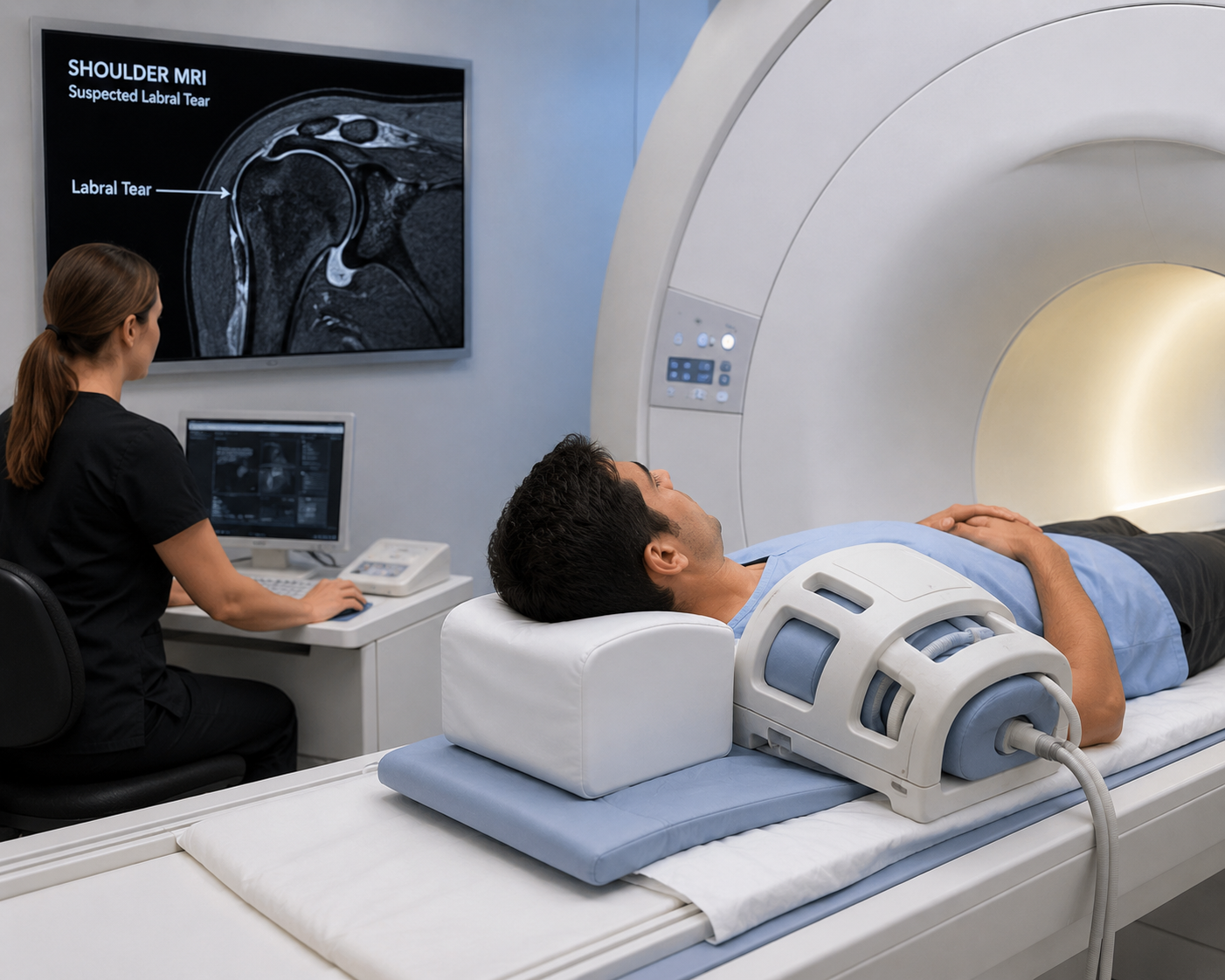
Imaging. An X-ray checks the bone. An MRI confirms the tear — and because labral tears can be hard to see on a standard MRI, the scan is sometimes performed as an MR arthrogram, with contrast injected into the joint to outline the labrum clearly. Aptiva Health operates its own MRI imaging centers, so most patients can get same-week MRI scheduling without the multi-week wait that hospital-based imaging typically requires.
Treatment plan. After the exam and imaging, your provider walks you through the diagnosis, the surgical and non-surgical options, and the recovery timeline. You leave with a written plan.
Treatment for a Torn Labrum
The right treatment depends on which type of labral tear is present, whether the shoulder is unstable, the patient's age and activity level, and how the shoulder is functioning.
Non-surgical treatment
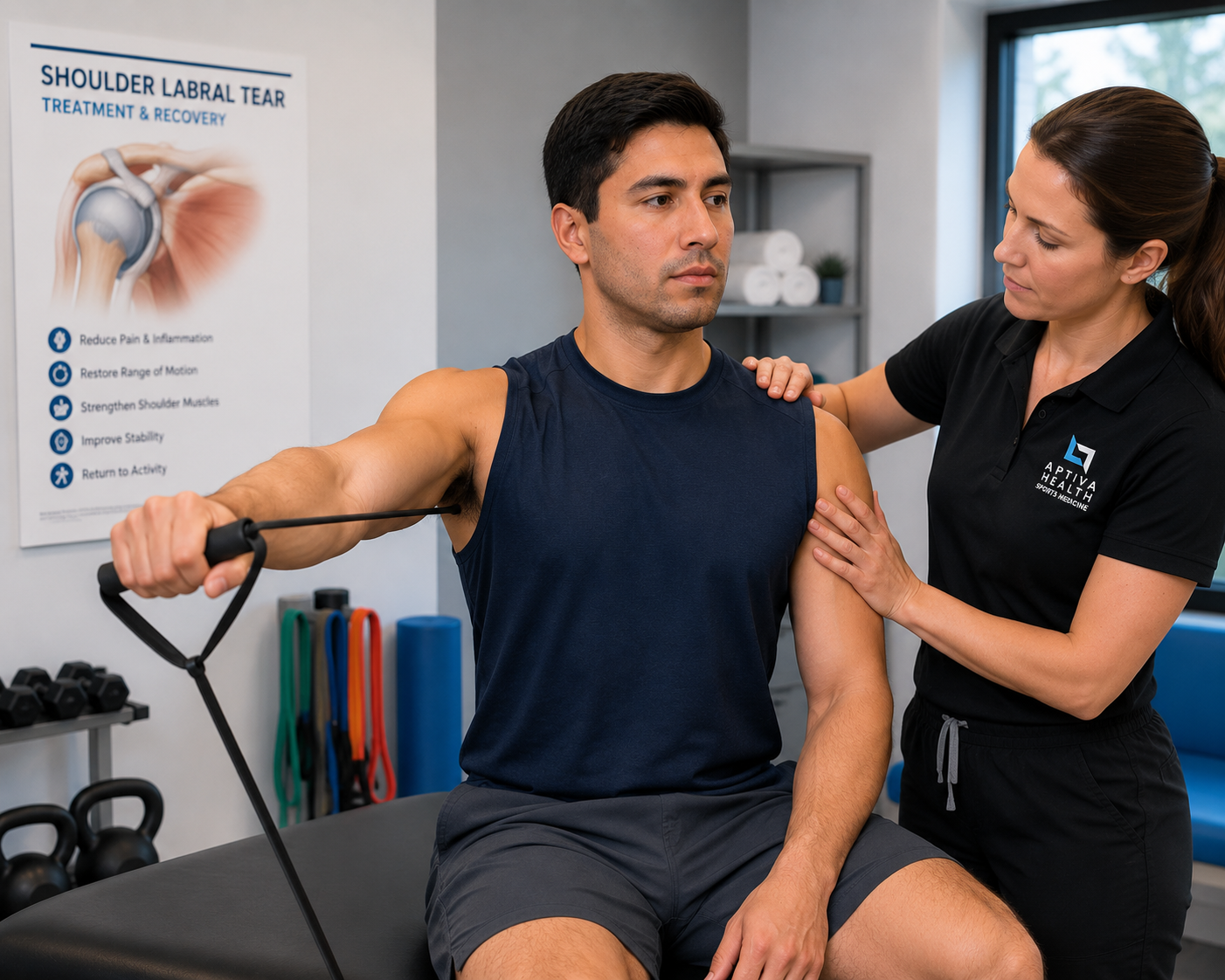
Many labral tears — particularly degenerative SLAP tears and tears that are not causing instability — are managed successfully without surgery. Conservative care includes physical therapy to strengthen the rotator cuff and the muscles that stabilize the shoulder, activity modification, anti-inflammatory medication, and targeted injections. Many patients regain a comfortable, functional shoulder without an operation.
Surgical treatment: arthroscopic labral repair
When a labral tear causes recurrent instability, when it affects an athlete who needs a stable, powerful shoulder, or when conservative care has not relieved the symptoms, arthroscopic labral repair is the next step. Working through small incisions with a camera and instruments, the surgeon reattaches the torn labrum to the rim of the shoulder socket using small suture anchors:
SLAP repair — reattaching a torn upper labrum at the biceps anchor.
Bankart repair (shoulder stabilization) — reattaching the torn front-lower labrum and the stabilizing structures to stop recurrent dislocation.
Posterior labral repair — reattaching a tear at the back of the labrum.
Labral repair is typically performed on an outpatient basis.
Learn more about labral tears and shoulder anatomy →
SLAP repair vs. biceps tenodesis
Not every SLAP tear is best treated by repairing the labrum directly. Because the biceps tendon attaches at the top of the labrum, a degenerative SLAP tear in an older or lower-demand patient is sometimes better treated with a biceps tenodesis — re-anchoring the biceps tendon to the upper arm bone — which reliably relieves pain and avoids the stiffness that a direct SLAP repair can sometimes cause. Aptiva's shoulder surgeon chooses between SLAP repair and biceps tenodesis based on the patient's age, activity level, and the condition of the tissue.
Recovery after labral repair
Recovery is a staged process. The arm is protected in a sling for roughly four to six weeks while the repaired labrum begins to heal to the bone. Physical therapy then progresses in stages — first restoring motion, then rebuilding strength and, for athletes, sport-specific function. A return to sport typically takes four to six months. Aptiva Health coordinates post-operative physical therapy in-house, so the surgical team and the therapy team share the same plan — which keeps rehabilitation on track.
Why Patients Choose Aptiva Health for Shoulder Labrum Care in Northern Kentucky
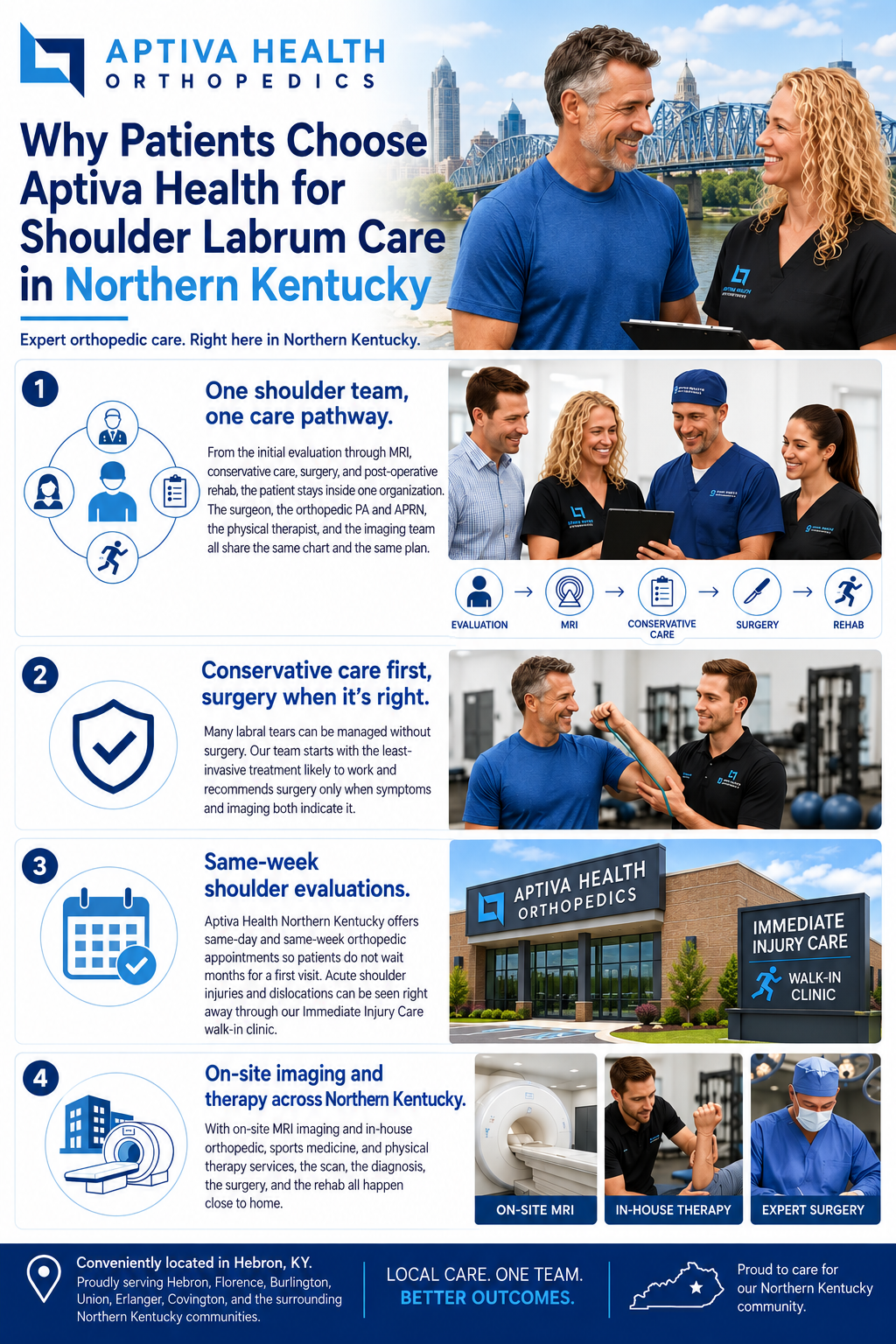
One shoulder team, one care pathway.
From the initial evaluation through MRI, conservative care, surgery, and post-operative rehab, the patient stays inside one organization. The surgeon, the orthopedic PA and APRN, the physical therapist, and the imaging center all share the same chart and the same plan.
Conservative care first, surgery when it's right.
Many labral tears can be managed without surgery. Our team starts with the least-invasive treatment likely to work and recommends surgery only when symptoms and imaging both indicate it.
Same-week shoulder evaluations.
Aptiva Health Northern Kentucky offers same-day and same-week orthopedic appointments — patients do not wait months for a first visit. Acute shoulder injuries and dislocations can be seen right away through our Immediate Injury Care walk-in clinic.
On-site imaging and therapy across Northern Kentucky.
With on-site MRI imaging and in-house orthopedic, sports medicine, and physical therapy services, the scan, the diagnosis, the surgery, and the rehab all happen close to home.
Schedule your appointment today!
When to See a Doctor
You should be evaluated by an orthopedic specialist if you have:
Deep shoulder pain that has not improved after four to six weeks of rest and conservative care
A shoulder that catches, locks, or pops with movement
A shoulder that feels loose, slips, or has dislocated
A shoulder dislocation — especially a first dislocation in a younger, active patient
For athletes, a loss of throwing velocity or overhead power
A shoulder injury from sports, a fall, or a work or auto accident
Get to an emergency room or urgent care immediately if your shoulder is dislocated and will not go back into place, you cannot move the arm after an injury, or you have numbness or loss of circulation in the arm or hand.
For non-emergency shoulder evaluation, Aptiva Health Louisville offers same-day and same-week appointments.
Meet the Northern Kentucky Shoulder Treatment Team

D. Philip Stickney, MD — Orthopedic Surgery.
D. Philip Stickney, MD, a board -certified orthopedic surgeon, has been providing general orthopedic care for over 25 years. He received his medical degree from Case Western Reserve University in Cleveland, Ohio with orthopedic surgery training at Mt. Sinai in Cleveland and Akron General Medical Center in Akron, Ohio. He treats a variety of conditions from arthritis to sports medicine and occupational injuries.
Schedule a Shoulder Labrum Consultation in Northern Kentucky — Schedule Now
Aptiva Health – Northern Kentucky: 2093 Medical Arts Drive, Hebron, KY 41048
Drive times:
5 minutes from CVG (Cincinnati/Northern Kentucky International Airport)
10 minutes from Florence, KY via I-71/75
12 minutes from Burlington and Union via KY-237
15 minutes from downtown Cincinnati via I-275 East
18 minutes from Covington and Newport
20 minutes from Anderson Township and Mt. Washington (OH)
25 minutes from Price Hill, Westwood, and Delhi Township
30 minutes from Florence Mall and the Boone County line south
Communities we routinely serve: Hebron, Florence, Burlington, Union, Walton, Erlanger, Edgewood, Crestview Hills, Fort Mitchell, Fort Wright, Independence, Covington, Newport, Fort Thomas, Cold Spring, Alexandria, Highland Heights, and across the river in Cincinnati, Anderson Township, Delhi Township, Cheviot, Price Hill, and Westwood.
Hours: Monday–Friday, 8:00 AM – 5:00 PM. Walk-in injury care availability may vary; call ahead to confirm.
Insurance accepted: Most major medical insurance, Medicare, Medicare Advantage, most Kentucky Medicaid plans, workers' compensation, auto injury coverage (PIP and MedPay), and cash-pay.
Frequently Asked Questions About Shoulder Labrum Repair in Northern Kentucky
What is the shoulder labrum?
The labrum is a rim of cartilage that lines and deepens the shoulder socket. It helps keep the ball of the upper arm bone centered in the socket, supports shoulder stability, and serves as an attachment point for the biceps tendon and shoulder ligaments. A labral tear can cause pain, catching, weakness, or a feeling that the shoulder is unstable.
What is the difference between a SLAP tear and a Bankart tear?
Both are labral tears, but they occur in different areas of the shoulder.
A SLAP tear affects the upper portion of the labrum where the biceps tendon attaches. SLAP tears are often associated with repetitive overhead activity and may cause deep shoulder pain, clicking, or catching.
A Bankart tear affects the front-lower portion of the labrum and is commonly associated with a shoulder dislocation. Because Bankart tears can contribute to recurrent instability, accurate diagnosis is important when determining the right treatment approach.
Do labral tears need surgery?
Not always. Some labral tears can be managed without surgery using physical therapy, activity modification, medication, and injections when appropriate.
Surgery may be considered when a labral tear causes recurrent instability, repeated dislocations, ongoing pain or functional limitations, or symptoms that have not improved enough with conservative treatment. D. Philip Stickney, MD reviews your symptoms, physical exam, and imaging to determine the most appropriate treatment plan.
Does a Bankart tear need surgery?
A Bankart tear may be more likely to require surgical treatment when it causes recurrent shoulder instability or repeated dislocations. Treatment depends on factors such as the severity of the injury, age, activity level, number of dislocations, and overall shoulder function.
Dr. Stickney will review your examination and imaging to determine whether non-surgical care or surgical stabilization may be appropriate.
How is shoulder labrum repair performed?
Shoulder labrum repair is commonly performed arthroscopically using small incisions, a camera, and specialized instruments. During the procedure, the surgeon may reattach the torn labrum to the edge of the shoulder socket using small suture anchors.
The exact procedure depends on the type and location of the tear. A SLAP repair addresses damage at the top of the labrum, while a Bankart repair addresses instability-related damage at the front-lower portion of the labrum. In some cases, a biceps tenodesis may be considered instead of or along with a SLAP repair.
What is a biceps tenodesis and why is it sometimes done instead of a SLAP repair?
A biceps tenodesis is a procedure that repositions the attachment of the biceps tendon to the upper arm bone. Because the biceps tendon attaches near the upper labrum, certain SLAP tears can involve both structures.
Depending on factors such as age, activity level, tissue quality, and the type of injury, your surgeon may recommend a biceps tenodesis rather than directly repairing the labrum. Dr. Stickney can explain which approach may be appropriate for your shoulder.
How long is recovery after shoulder labrum repair?
Recovery after labrum repair is gradual and depends on the type of repair, the severity of the injury, and the individual patient. A sling may be used during the early healing period, followed by a structured physical therapy program to gradually restore motion, strength, and shoulder stability.
Your Aptiva Health Northern Kentucky orthopedic team will provide individualized guidance for returning to work, exercise, sports, and other activities.
How is a torn labrum diagnosed?
A torn labrum is typically evaluated through a discussion of symptoms and injury history, a physical examination, and imaging when appropriate.
X-rays may be used to evaluate the bones of the shoulder, while MRI can provide more detailed information about the labrum and other soft tissues. Aptiva Health Northern Kentucky offers coordinated access to orthopedic care and imaging, helping patients move efficiently from evaluation to treatment planning.
Who performs shoulder labrum repair at Aptiva Health Northern Kentucky?
Shoulder labrum repair and other orthopedic shoulder procedures at Aptiva Health Northern Kentucky are performed by D. Philip Stickney, MD, a board-certified orthopedic surgeon who treats a wide range of shoulder conditions and injuries.
Dr. Stickney provides both surgical and non-surgical orthopedic care and works with Aptiva Health’s imaging and physical therapy teams to coordinate treatment from diagnosis through rehabilitation.
How quickly can I be seen for a shoulder injury in Northern Kentucky?
Aptiva Health Northern Kentucky offers convenient orthopedic appointment availability for patients with acute shoulder injuries, ongoing pain, instability, or an existing diagnosis.
Patients who already have X-rays, MRI images, or prior medical records are encouraged to bring them to their appointment. For more urgent orthopedic concerns, Aptiva Health also offers Immediate Injury Care services.
Does insurance cover shoulder labrum surgery?
Coverage for shoulder labrum evaluation and surgery depends on your individual insurance plan, benefits, medical necessity, and authorization requirements. Aptiva Health works with many major commercial insurance plans, Medicare, Medicare Advantage, Medicaid plans, workers' compensation, and auto-injury coverage.
Labral injuries related to a work injury or auto accident may also be treated through the appropriate coverage. Aptiva Health can help verify benefits before treatment.