

SI Joint Fusion in Northern Kentucky
SI Joint Fusion is a minimally invasive procedure that uses small lateral incisions, titanium iFuse implants, and same-day discharge to stabilize the sacroiliac joint and eliminate chronic SI joint pain. Dr. Jaideep Chunduri lead Aptiva Health's SI joint fusion program in Northern Kentucky. The sacroiliac joint is responsible for an estimated 20 to 25 percent of chronic low back pain and is one of the most commonly missed diagnoses in spine care.
Medically reviewed by Jaideep Chunduri, MD — August 2026.
Schedule your appointment today!
SI Joint Fusion — Stabilizing the Joint That Connects Your Spine to Your Pelvis
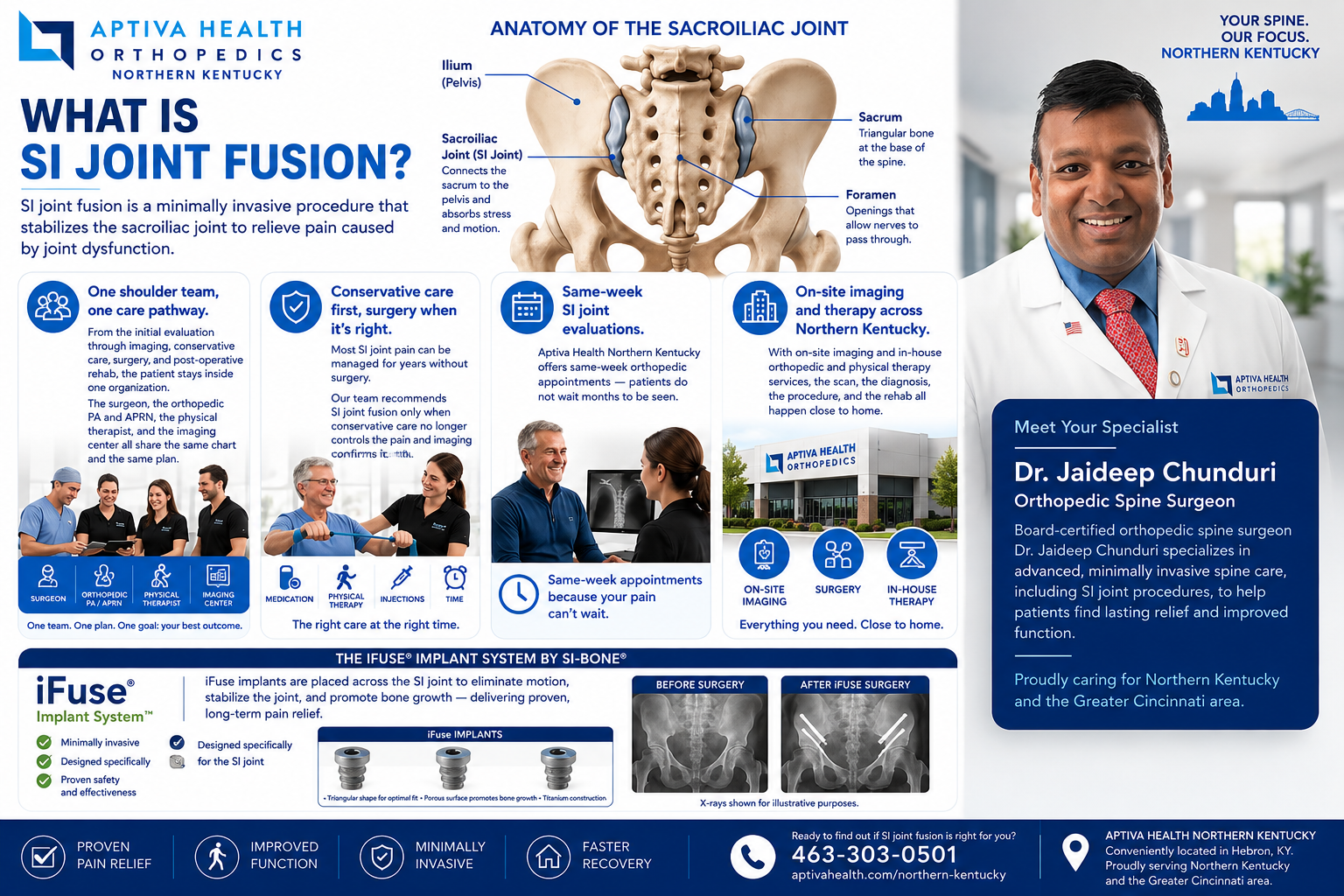
The sacroiliac (SI) joint is the strong, weight-bearing joint where the bottom of your spine (the sacrum) meets the back of your pelvis (the iliac bone). You have two of them — one on each side — and together they transfer the entire load of your upper body to your hips and legs every time you stand, walk, climb stairs, or get out of a chair.
When the SI joint becomes painful, dysfunctional, or unstable — from injury, arthritis, pregnancy, prior lumbar fusion, or simple wear and tear — the result is chronic lower back, buttock, hip, or groin pain that often gets misdiagnosed as a lumbar disc problem, sciatica, or hip pain. Many SI joint patients live with the pain for years before getting the right diagnosis.
SI joint fusion is the surgical solution when conservative care has failed. The procedure stabilizes the SI joint by placing titanium implants across it, eliminating the abnormal motion that generates pain. Over the following months, bone grows directly into the porous surface of the implants for a permanent biological fusion.
At Aptiva Health in Indianapolis, SI joint fusion is performed using the iFuse Implant System — a set of three triangular titanium implants engineered specifically for the sacroiliac joint. The procedure is done through a small lateral incision under continuous fluoroscopic guidance, takes about an hour, and most patients go home the same day.
SI joint fusion does not fuse any part of your spine itself. The vertebrae continue to move normally afterward. Only the sacroiliac joint — which is meant to have very little motion in the first place — is locked in place.
Conditions We Treat With SI Joint Fusion
SI joint fusion is reserved for patients with chronic, confirmed sacroiliac joint pain that has not responded to a structured course of conservative and interventional care. The most common indications include:
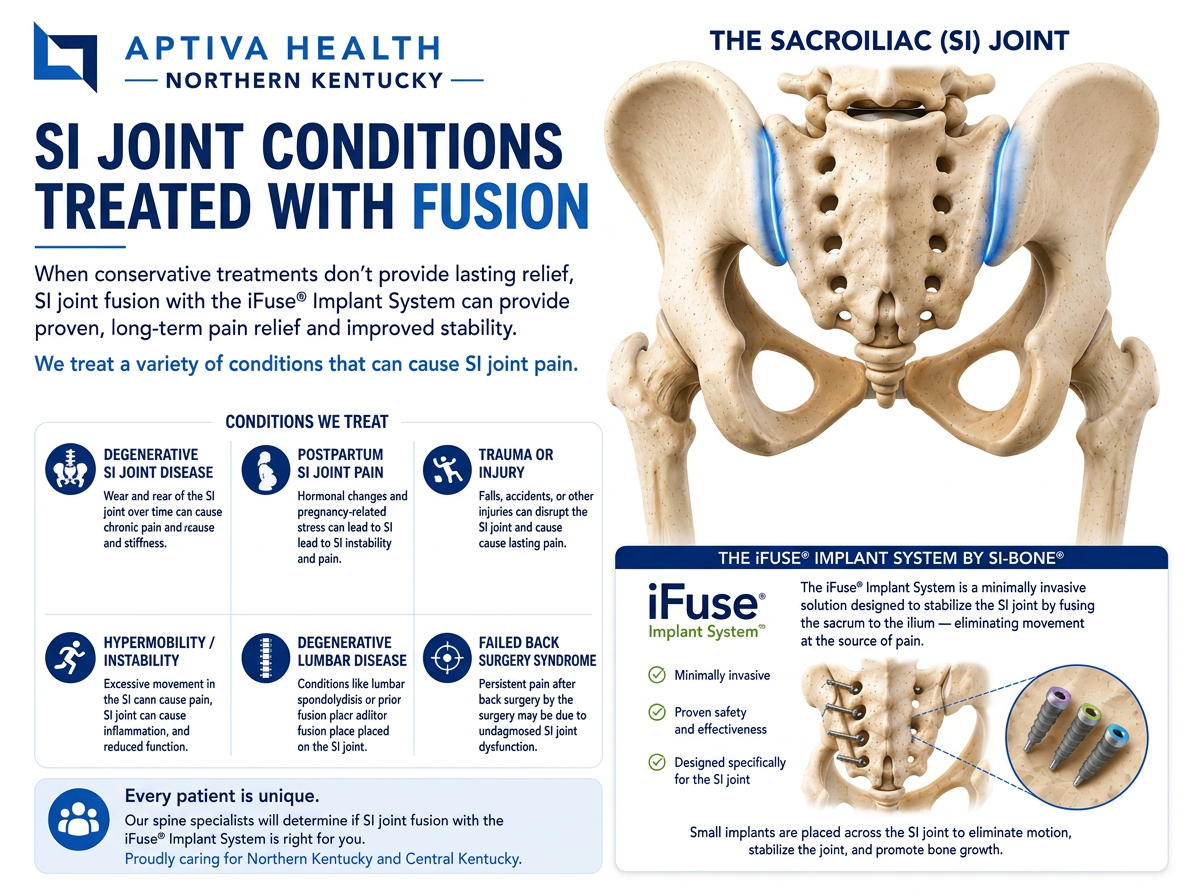
Chronic SI joint dysfunction — pain from abnormal motion or alignment of the sacroiliac joint, lasting six months or longer
Post-traumatic SI joint pain — sacroiliac joint injuries from auto accidents, falls, or other trauma; one of the most common causes of SI joint pain in working-age adults
SI joint arthritis and degeneration — wear-and-tear breakdown of the cartilage in the joint over time
Post-pregnancy SI joint instability — sometimes called pelvic girdle pain; pregnancy hormones loosen pelvic ligaments and the SI joint sometimes does not fully restabilize after delivery
Adjacent-segment SI joint dysfunction after lumbar fusion — approximately 30 to 40 percent of patients who have had a lumbar fusion will eventually develop SI joint dysfunction because the fusion transfers additional mechanical stress to the SI joint
Sacroiliitis from inflammatory arthritis — selected cases of ankylosing spondylitis or psoriatic arthritis with severe joint destruction
Work injuries involving the SI joint, especially in occupations involving repetitive lifting, bending, or twisting
The SI joint is one of the most commonly missed diagnoses in spine care because its pain pattern mimics so many other conditions. Not sure if your back pain is an SI joint problem, a lumbar disc problem, or a hip problem? Compare options on our Spine Surgery Northern Kentucky, Microdiscectomy Northern Kentucky, and Laminectomy Northern Kentucky pages, or get evaluated by an Aptiva spine provider.
Minimally Invasive iFuse vs. Traditional Open SI Arthrodesis — and When to Choose Surgery
Minimally Invasive SI Joint Fusion (What Aptiva Performs)
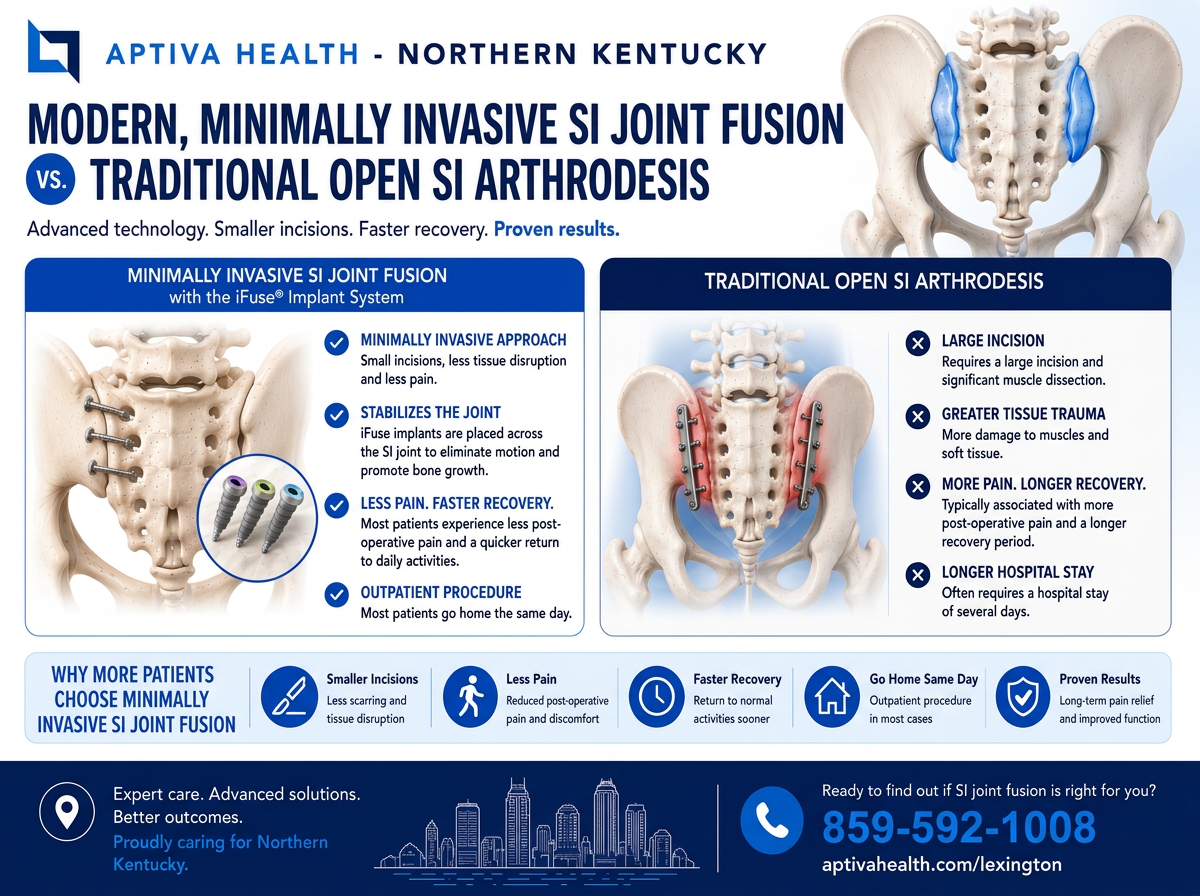
Small lateral incision approximately 1 to 2 inches
Three triangular titanium iFuse implants placed across the joint
No separate bone graft harvest required — porous titanium surface promotes biological bone ingrowth
C-arm fluoroscopic image guidance throughout
Outpatient — same-day discharge for most patients
Surgery time: approximately one hour
Walking same day with walker or crutches
Full weight-bearing within a few weeks for most patients
Return to desk work: 1 to 2 weeks
Return to physical labor: 12 to 16 weeks
Traditional Open SI Joint Arthrodesis (What Aptiva Does NOT Perform)
Large posterior incision
Significant bone graft harvested from the iliac crest (an additional source of post-op pain)
Inpatient hospital stay required
Months of non-weight-bearing historically required
Higher rate of wound complications and longer overall recovery
Largely replaced by minimally invasive techniques in modern spine practice
SI Joint Fusion vs. Continued Conservative or Injection Care
Most SI joint pain can be managed without surgery. Surgical fusion is reserved for patients who have:
Failed at least six months of structured conservative care — physical therapy with SI joint stabilization, anti-inflammatory medication, activity modification
At least one positive diagnostic SI joint injection confirming the SI joint as the pain generator (most surgeons want one or two confirmatory blocks)
Failed or short-lived response to therapeutic interventions — fluoroscopy-guided corticosteroid SI joint injections and often SI joint radiofrequency ablation (lateral branch RFA)
A clear clinical picture — pain centered at the SI joint, positive provocative SI joint exam tests, and SI joint–pattern symptoms
The bottom line: Aptiva's surgeons recommend SI joint fusion only when the diagnosis is confirmed and conservative options have been exhausted. For patients who still have meaningful options short of surgery, Dr. Steven Ganzel provides the full continuum of SI joint interventional pain procedures — many of which provide lasting relief and avoid the need for fusion entirely.
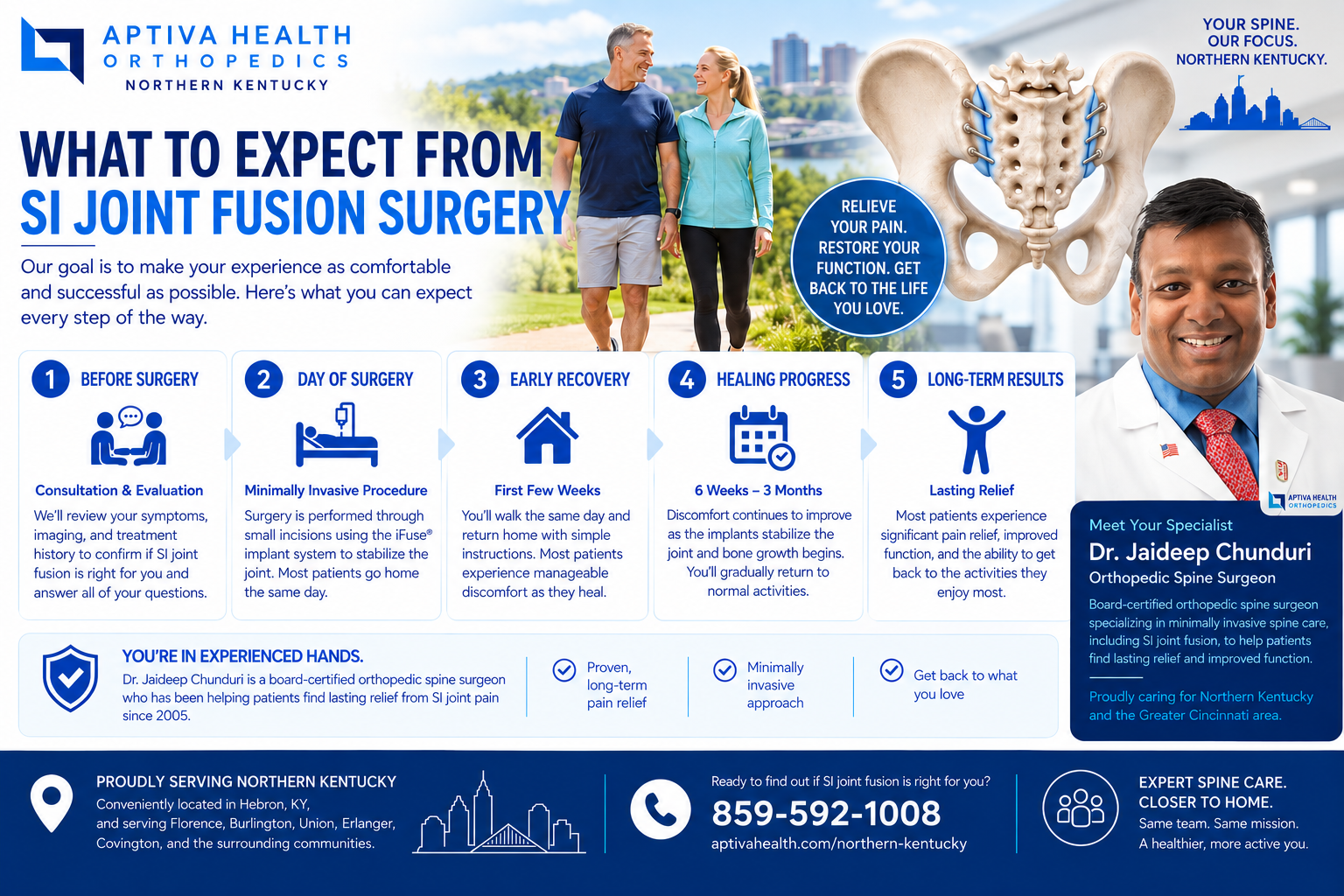
What to Expect From SI Joint Fusion Surgery
Before Surgery
Comprehensive evaluation by your Aptiva spine surgeon, including pain mapping and provocative SI joint physical exam tests (Patrick/FABER, Gaenslen, thigh thrust, distraction, and compression maneuvers)
Lumbar MRI and/or pelvic CT at Aptiva Health Imaging to rule out other sources of pain such as lumbar disc herniation, spinal stenosis, or hip pathology
One or two diagnostic SI joint injections performed under fluoroscopic guidance by Dr. Ganzel to confirm the SI joint as the pain generator
Confirmation that conservative care has been exhausted (physical therapy, anti-inflammatories, activity modification, therapeutic SI joint injections, and typically SI joint radiofrequency ablation)
Pre-operative consultation with your Aptiva spine surgeon to review imaging, symptoms, and surgical plan
Medical clearance and pre-operative labs
Fasting instructions per anesthesia protocol
Arrange a ride home — you cannot drive yourself the day of surgery, and you'll need help at home for the first few days
Day of Surgery
Arrive 1 to 2 hours before surgery start time at the outpatient ambulatory surgery center
General anesthesia administered
Patient positioned on the operative side
Small lateral incision (approximately 1 to 2 inches) made over the affected SI joint
Under continuous C-arm fluoroscopic guidance, three triangular titanium iFuse implants are placed across the SI joint, anchoring the sacrum to the ilium
The porous titanium plasma spray coating on the implants is designed to allow bone to grow directly into the implant surface for long-term biological fusion
Incision closed in layers
Total surgical time: approximately one hour
2 to 3 hours in post-anesthesia recovery
Discharge home the same day for most patients
You will leave with a walker or crutches
After Surgery
Walking with walker or crutches the same day of surgery
Partial weight-bearing on the operative side for approximately 2 to 3 weeks (many patients progress rapidly to full weight-bearing)
Most patients report meaningful relief of SI joint pain within the first few weeks
Pain medication tapered as tolerated
Desk work: typically 1 to 2 weeks
Driving: typically 2 to 3 weeks (once off narcotic pain medication and you can safely operate the pedals)
Light exercise: 6 to 8 weeks
Physical labor and high-impact activity: 12 to 16 weeks
Bone-to-implant fusion continues to mature over 6 to 12 months
Post-operative follow-up at 2 weeks, 6 weeks, 3 months, 6 months, and 12 months
Post-operative physical therapy at Aptiva typically begins around 2 to 4 weeks
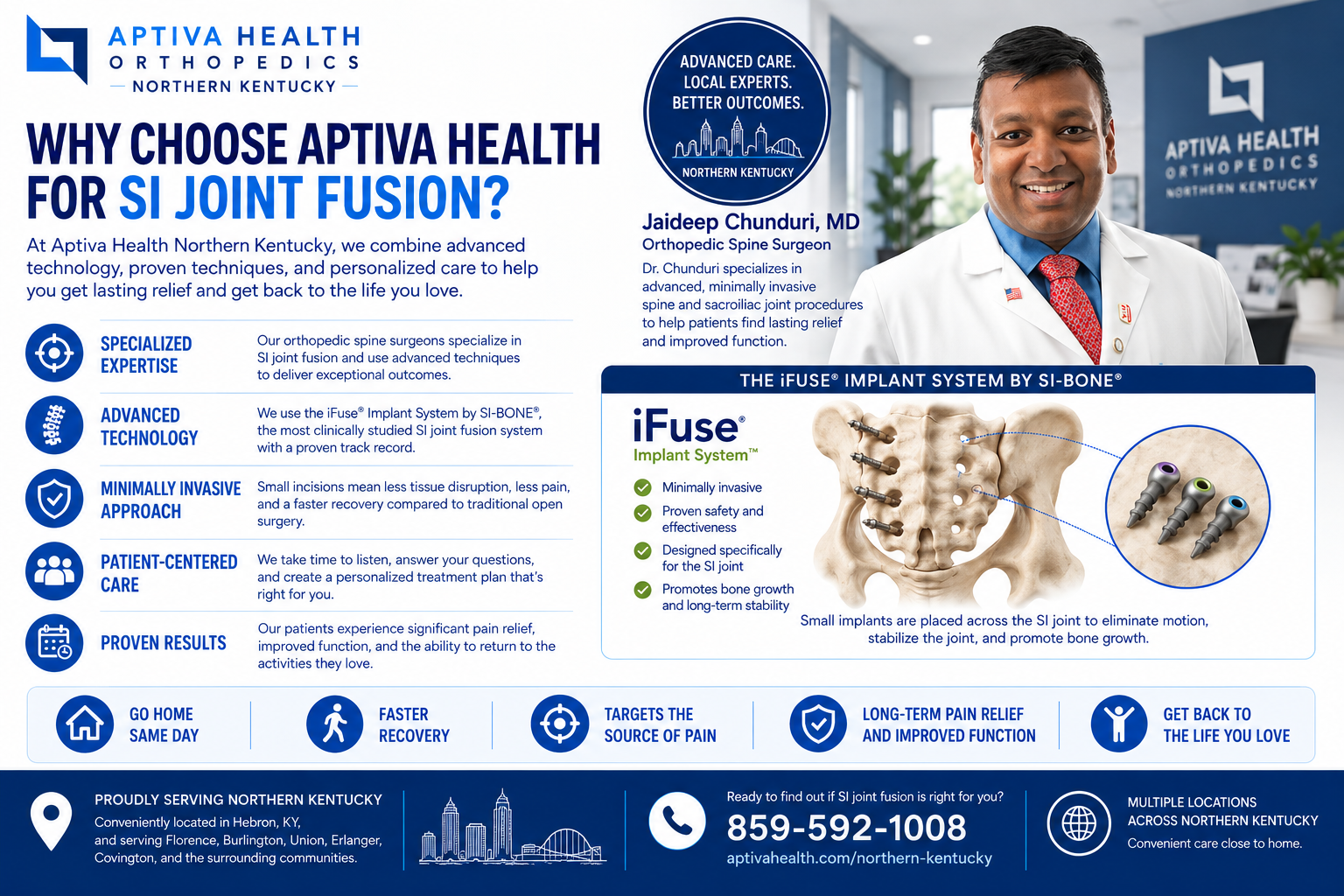
Why Choose Aptiva Health for Your SI Joint Fusion
A surgeon with over 20 years experience. Dr. David McConda is a board-certified orthopedic spine surgeon at Aptiva Health, fellowship-trained at OrthoCarolina Spine Center in Charlotte through the AOSpine North America Spine Surgery Fellowship — the premier spine-surgery training program of AOSpine, the international foundation that sets clinical standards in spine care.
Minimally invasive technique only. Aptiva does not perform traditional open SI joint arthrodesis. All SI joint fusions at Aptiva are performed using the minimally invasive lateral approach with the iFuse Implant System — small incision, image guidance, outpatient setting, rapid return to weight-bearing.
A dedicated spine team. Spine and SI joint care isn't a side specialty at Aptiva — it's a focus. Our Lexington team includes board-certified spine and orthopedic surgeons, an interventional pain physician, and dedicated PAs and an NP who care for spine and SI joint patients every day.
The full SI joint diagnostic and treatment continuum. Dr. Steven Ganzel, our interventional pain specialist, performs diagnostic and therapeutic SI joint injections, SI joint lateral branch blocks, and SI joint radiofrequency ablation — non-surgical procedures that confirm the diagnosis and often provide lasting relief that avoids the need for fusion entirely.
Honest guidance — fusion only when conservative care has failed. Most SI joint pain can be effectively managed without surgery. We recommend SI joint fusion only after the diagnosis has been confirmed with positive diagnostic injections and conservative care has been fully exhausted.
Fast access. Most patients see an Aptiva spine provider within days of calling. Stop waiting weeks for an answer.
One team, start to finish. From your first call to your final post-op visit, you'll work with the same Aptiva team. We handle insurance verification, scheduling, and post-op care in-house.
Cash-pay options available. For patients without insurance — or with high deductibles — we offer transparent, all-inclusive cash-pay pricing for SI joint fusion that includes the surgeon, facility, anesthesia, and post-operative visits. No surprise hospital bills.
Schedule your appointment today!
Your Northern Kentucky Spine Care Team
At Aptiva Health, your spine and SI joint care is delivered by a team of board-certified surgeons and advanced practice providers who focus on the diagnosis, treatment, and follow-up of conditions of the spine and sacroiliac joint — including SI joint dysfunction, spinal stenosis, herniated discs, sciatica, and degenerative spine conditions.

Jaideep Chunduri, MD | Orthopedic Spine Surgeon
Dr. Jaideep Chunduri is an orthopedic spine surgeon at Aptiva Health and one of the most experienced spine surgeons in the tri-state region. He is the former Director of Orthopaedic Spine Surgery at TriHealth in Cincinnati, a founding orthopedic spine surgeon at Beacon Orthopedics, and SCOI fellowship-trained. He sees patients in Northern Kentucky, Indianapolis (beginning May 21, 2026), and the Greater Cincinnati region.

Steven Ganzel, DO — Physical Medicine & Rehabilitation, Interventional Pain Management
Dr. Ganzel is double board-certified in Physical Medicine & Rehabilitation and Interventional Pain Management. For the Aptiva Health Spine Team, he performs fluoroscopy-guided epidural steroid injections, facet joint injections, medial branch blocks, radiofrequency ablation, and other interventional pain procedures for patients — many of which provide lasting relief and prevent the need for surgical intervention.

Insurances Accepted
Aptiva Health accepts most major insurance plans, Medicare, Medicaid Managed Care, workers' compensation, and auto insurance (PIP and Medpay). We verify benefits and provide a clear cost estimate before surgery.
Minimally invasive SI joint fusion using the iFuse Implant System is a well-established procedure covered by Medicare and most major commercial insurance plans when medically necessary. Coverage typically requires documentation of failed conservative care, positive diagnostic SI joint injections, and a clinical picture consistent with SI joint pain.
For patients paying out of pocket, we offer transparent, bundled cash-pay pricing for SI joint fusion that includes the surgeon, facility, anesthesia, and post-operative visits — no surprise itemized hospital bills.
Call 859-592-1008 to verify your insurance or request a cash-pay quote.

Ready for Relief From Chronic SI Joint Pain?
If you've been suffering with chronic lower back, buttock, hip, or groin pain — especially pain that's worse with sitting, climbing stairs, getting in and out of a car, or rolling over in bed — and conservative care hasn't worked, it's time to talk to Aptiva's spine team about whether SI joint fusion is right for you.
Schedule a Consultation in Northern Kentucky — Schedule Now
Aptiva Health – Northern Kentucky: 2093 Medical Arts Drive, Hebron, KY 41048
Drive times:
5 minutes from CVG (Cincinnati/Northern Kentucky International Airport)
10 minutes from Florence, KY via I-71/75
12 minutes from Burlington and Union via KY-237
15 minutes from downtown Cincinnati via I-275 East
18 minutes from Covington and Newport
20 minutes from Anderson Township and Mt. Washington (OH)
25 minutes from Price Hill, Westwood, and Delhi Township
30 minutes from Florence Mall and the Boone County line south
Communities we routinely serve: Hebron, Florence, Burlington, Union, Walton, Erlanger, Edgewood, Crestview Hills, Fort Mitchell, Fort Wright, Independence, Covington, Newport, Fort Thomas, Cold Spring, Alexandria, Highland Heights, and across the river in Cincinnati, Anderson Township, Delhi Township, Cheviot, Price Hill, and Westwood.
Hours: Monday–Friday, 8:00 AM – 5:00 PM. Walk-in injury care availability may vary; call ahead to confirm.
Insurance accepted: Most major medical insurance, Medicare, Medicare Advantage, most Kentucky Medicaid plans, workers' compensation, auto injury coverage (PIP and MedPay), and cash-pay.

SI Joint Fusion in Northern Kentucky: Frequently Asked Questions
What is SI joint fusion?
SI joint fusion is a surgical procedure designed to stabilize the sacroiliac joint — the joint where the sacrum at the bottom of the spine meets the pelvis. The goal is to reduce painful abnormal motion by placing implants across the joint to support stability and fusion.
At Aptiva Health Northern Kentucky, Jaideep Chunduri, MD evaluates patients with suspected SI joint dysfunction and determines whether minimally invasive SI joint fusion may be an appropriate treatment option.
What conditions does SI joint fusion treat?
SI joint fusion may be considered for persistent pain related to SI joint dysfunction that has not improved enough with conservative treatment. SI joint problems may develop after trauma such as a car accident or fall, degenerative changes, pregnancy-related pelvic changes, or increased stress on the SI joint after previous lumbar spine surgery.
Because SI joint pain can resemble other causes of low back pain, a careful evaluation is important before surgery is considered.
How do I know if my SI joint is actually the source of my pain?
SI joint symptoms can overlap with conditions such as disc herniation, sciatica, hip disorders, and other sources of lower-back or buttock pain.
Evaluation may include a detailed history, physical examination, imaging when appropriate, and a diagnostic SI joint injection. Relief following a carefully performed diagnostic injection can provide useful information about whether the SI joint is contributing to your symptoms.
Dr. Chunduri reviews these findings as part of the overall evaluation before recommending surgical treatment.
Is SI joint fusion an outpatient procedure?
Minimally invasive SI joint fusion may be performed on an outpatient or short-stay basis for appropriately selected patients. Whether you return home the same day depends on your overall health, the procedure performed, and how you recover after surgery.
Your Aptiva Health Northern Kentucky surgical team will explain what to expect before your procedure.
Am I a candidate for SI joint fusion?
SI joint fusion may be considered when persistent lower-back, buttock, or pelvic-region pain has been linked to the SI joint and non-surgical treatment has not provided adequate improvement.
Conservative care may include physical therapy, medication, activity modification, SI joint injections, or other interventional pain-management options when appropriate.
A consultation with Jaideep Chunduri, MD can help determine whether SI joint fusion or another treatment approach may be appropriate based on your symptoms, examination, imaging, and previous treatment.
How long does SI joint fusion surgery take?
Procedure time varies depending on the individual patient and the surgical approach. Your surgeon will discuss the anticipated length of surgery, anesthesia, and recovery process with you before the procedure.
How long is recovery after SI joint fusion?
Recovery varies from patient to patient. Walking typically begins early in the recovery process, with activity gradually increased according to your surgeon’s instructions.
Returning to work, driving, exercise, lifting, and more strenuous activities depends on your procedure, occupation, overall health, and progress during recovery. Your Aptiva Health Northern Kentucky spine team will provide individualized guidance and follow-up as healing progresses.
What results can I expect from SI joint fusion?
The goal of SI joint fusion is to improve stability of the affected joint and reduce symptoms associated with painful SI joint motion. Outcomes vary based on factors such as diagnosis, overall health, severity and duration of symptoms, and response to previous treatment.
During your consultation, Dr. Chunduri will discuss the expected benefits, potential risks, limitations, and alternatives based on your individual condition.
What is the iFuse Implant System?
The iFuse Implant System, manufactured by SI-BONE, is an implant system designed specifically for stabilization and fusion of the sacroiliac joint.
The implants are placed across the SI joint to help provide stability while fusion develops. Whether iFuse or another surgical approach is appropriate depends on your diagnosis, anatomy, and treatment plan. Your surgeon can explain the specific technology being considered for your procedure.
What is the difference between minimally invasive SI joint fusion and traditional open SI joint surgery?
Minimally invasive SI joint fusion uses smaller incisions and specialized instruments to access and stabilize the SI joint while limiting disruption to surrounding tissues.
Traditional open approaches generally involve a larger surgical exposure and may require a different recovery process. The appropriate approach depends on the patient’s anatomy, diagnosis, prior surgery, and other individual factors.
Will my insurance cover SI joint fusion?
Coverage for SI joint fusion depends on your individual insurance plan, medical necessity, prior treatment requirements, and authorization criteria.
Aptiva Health works with many commercial insurance plans as well as Medicare, Medicaid Managed Care, workers’ compensation, and auto-injury coverage. The Aptiva Health team can help verify benefits and discuss anticipated coverage before treatment.
Who performs SI joint fusion at Aptiva Health Northern Kentucky?
SI joint fusion care at Aptiva Health Northern Kentucky is led by Jaideep Chunduri, MD, an orthopedic spine surgeon who evaluates and treats conditions affecting the cervical and lumbar spine as well as disorders involving the sacroiliac joint.
Patients also have access to coordinated non-surgical spine and pain care. Steven Ganzel, DO provides Physical Medicine & Rehabilitation and interventional spine care, including diagnostic injections and other non-operative treatments.
This multidisciplinary approach allows patients to explore conservative options as well as surgical treatment within the Aptiva Health system.
Can SI joint pain develop after a previous lumbar fusion?
Yes. SI joint symptoms can develop in some patients after lumbar fusion because the mechanics of the lower spine and pelvis may change after surgery.
Aptiva Health Northern Kentucky evaluates patients who develop new or persistent lower-back, buttock, or pelvic-region pain following a previous lumbar fusion, including patients whose original surgery was performed elsewhere.
Dr. Chunduri can help determine whether the SI joint, another area of the spine, or a different condition may be contributing to the symptoms.
Where can I see an SI joint specialist in Northern Kentucky?
Aptiva Health Northern Kentucky provides spine and orthopedic care in Hebron, Kentucky, serving patients throughout Northern Kentucky and the Greater Cincinnati area. Patients can access spine evaluation, imaging, physical therapy, interventional pain management, and surgical consultation through the Aptiva Health network.