

ACL Reconstruction in Northern Kentucky
Anterior Cruciate Ligament (ACL)
The anterior cruciate ligament (ACL) is located toward the front of the knee. It is the most common ligament to be injured. The ACL is often stretched and/or torn during a sudden twisting motion (when the feet stay planted one way, but the knees turn the other way). Skiing, basketball, and football are sports that have a higher risk of ACL injuries.
Medically reviewed by D. Philip Stickney, MD, August 2026.
Schedule your appointment today!
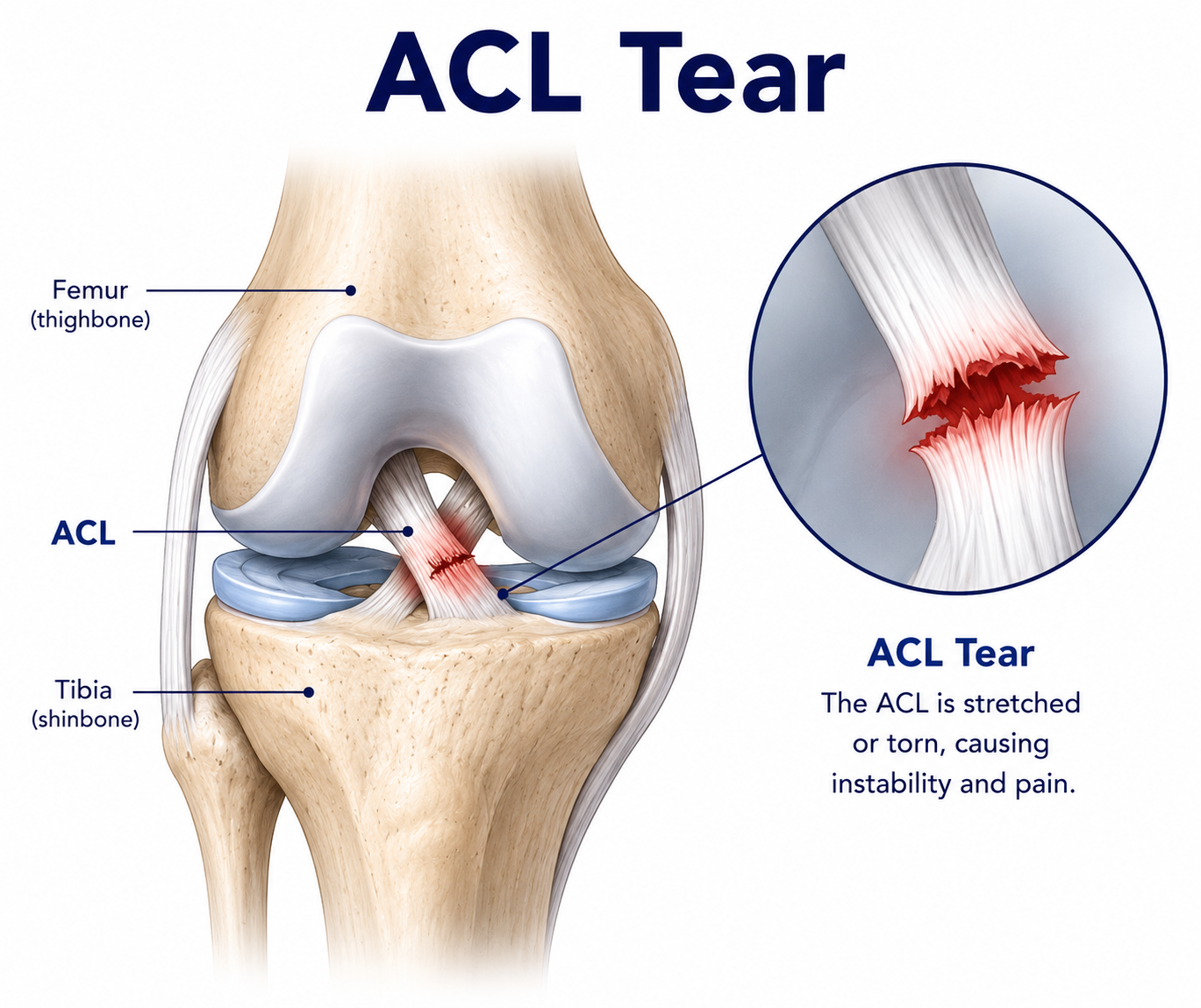
What is an ACL Tear?
The anterior cruciate ligament — the ACL — is one of four major ligaments that stabilize the knee. It runs diagonally through the middle of the joint, connecting the femur (thighbone) to the tibia (shinbone), and its job is to keep the knee from sliding forward or rotating out of place during movement.
When the ACL tears, the knee loses that stabilizing tether. Most patients describe feeling or hearing a pop at the moment of injury, followed by swelling within a few hours and a sense that the knee "isn't right" — that it shifts, gives out, or can't be trusted on a pivot or a stair.
ACL tears do not heal on their own. The ligament has a poor blood supply, and a complete tear leaves the two ends of the ligament unable to reconnect. In active patients, the standard of care is ACL reconstruction surgery — replacing the torn ligament with a graft that the body rebuilds into a new, functional ACL over four to six months.

Types of ACL Injuries
ACL injuries are diagnosed through clinical examination and MRI, and can be classified by the amount of damage to the ligament (partial or complete disruption). Injury to the ACL is usually a complete disruption, classifying it as a Grade III complete tear.
Grade I Sprain - There is some stretching and micro-tearing of the ligament, but the ligament is intact and the joint remains stable. These injuries rarely require surgery.
Grade II Sprain (Partial Disruption) - There is some tearing and separation of the ligament fibers and the ligament is partially disrupted. The joint is moderately unstable. Depending on the activity level of the patient and the degree of instability, these tears may or may not require surgery.
Grade III Sprain (Complete Disruption) - There is total rupture of the ligament fibers. The ligament is completely disrupted and the joint is unstable. Surgery is usually recommended in young or athletic people who engage in sports that involve cutting or pivoting.

Symptoms of an ACL Tear
If you've recently injured your knee, an ACL tear is likely if you experienced any of the following:
A "pop" at the moment of injury. Most patients hear or feel a distinct pop. About 50% of ACL tears are accompanied by an audible pop loud enough that other people nearby can hear it.
Sudden knee swelling within hours. Significant swelling within the first 6–24 hours is a hallmark of an ACL tear, caused by bleeding inside the joint (hemarthrosis).
Inability to continue the activity. Most patients cannot return to their game, practice, run, or activity. The knee feels unstable or unsafe to put weight on.
A feeling that the knee is "giving out." Even days or weeks after the initial injury, the knee buckles or shifts unexpectedly during walking, stairs, or pivots.
Loss of full range of motion. The knee may feel stiff, locked, or unable to fully straighten or bend.
Pain along the joint line and deep inside the knee. Tenderness is usually inside the joint rather than along the kneecap or below the knee.
Discomfort walking on uneven surfaces. Patients often describe stairs, hills, and grass as feeling unsafe.

How an ACL Tear Happens
The ACL can tear in several common ways. About 70% of ACL tears are non-contact injuries — they happen without anyone touching the knee:
Changing direction rapidly (cutting, pivoting)
Landing awkwardly from a jump
Stopping suddenly while running
Twisting with the foot planted (the classic "knee turned one way, foot stayed the other")
Direct contact or collision — football tackles, soccer slide tackles, skiing falls
The sports with the highest ACL injury rates are basketball, soccer, football, skiing, gymnastics, lacrosse, volleyball, and cheerleading.
Female athletes tear their ACLs at 2–8 times the rate of male athletes in the same sports. Several factors contribute: differences in hip-to-knee alignment, neuromuscular control, hamstring-to-quadriceps strength ratio, and the way the ACL behaves under hormonal cycles. Targeted neuromuscular training programs can cut female ACL injury risk significantly, and Aptiva's sports medicine and physical therapy teams provide ACL injury prevention training for athletes and teams.

How an ACL Tear Is Diagnosed
At Aptiva Health, an ACL tear diagnosis usually takes a single visit:
History. Your surgeon will ask about the mechanism of injury — what you were doing, whether you felt a pop, how quickly the knee swelled, and whether the knee has felt unstable since.
Physical examination. Specific tests — the Lachman test, the anterior drawer test, and the pivot-shift test — are highly accurate for identifying an ACL tear, often within minutes.
Imaging. An MRI confirms the diagnosis, shows the location of the tear, and identifies associated injuries (the meniscus, the cartilage, the MCL, or bone bruising) that are present in roughly half of ACL tears. Aptiva Health operates its own MRI imaging centers, so most patients can get same-week MRI scheduling without the multi-week wait that hospital-based imaging typically requires.
Treatment plan. After the exam and imaging, your surgeon will walk you through the diagnosis, the associated injuries, the surgical and non-surgical options, and the recovery timeline. You leave the visit with a written plan.
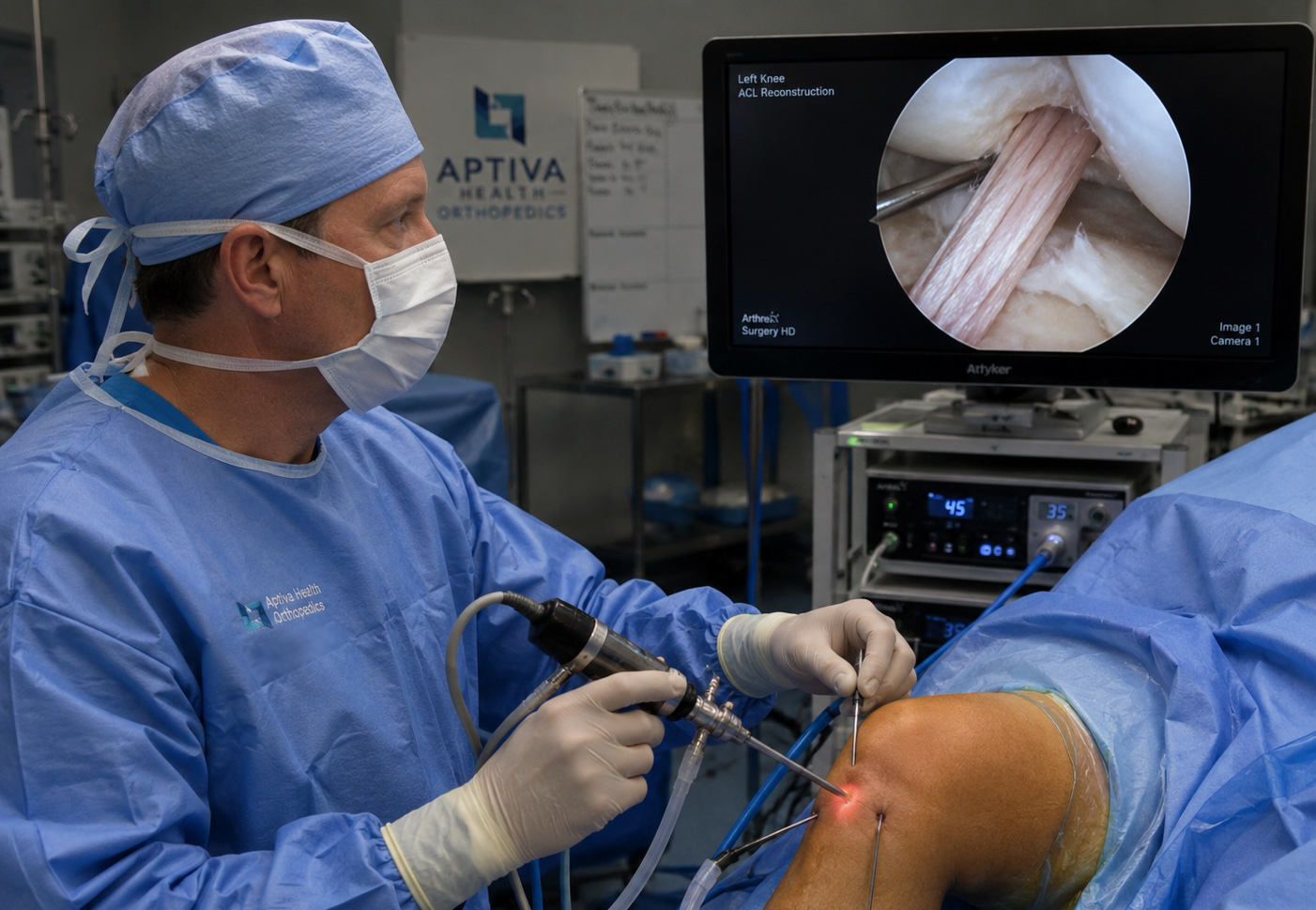
Treatment for an ACL Tear
ACL tear treatment depends on the patient's age, activity level, sport, work demands, and whether other knee structures (meniscus, cartilage, other ligaments) are also injured.
Non-surgical treatment
A complete ACL tear will not heal on its own, but some patients — typically older, lower-activity, or unwilling to undergo surgery — can manage a torn ACL with bracing, physical therapy, activity modification, and quad/hamstring strengthening. This approach trades knee stability for avoidance of surgery, and it works best for patients who don't need to cut, pivot, or land at speed.
Surgical treatment: ACL reconstruction
For the majority of patients — anyone who wants to return to sports, agility-based work, or an active lifestyle — the standard of care is ACL reconstruction surgery. The torn ligament is replaced with a graft (most often the patient's own patellar tendon, hamstring tendon, or quadriceps tendon; sometimes a cadaver allograft), and the new ligament is anchored in tunnels drilled into the femur and tibia. Over four to six months, the body remodels the graft into a functional ACL.
Learn more about ACL reconstruction surgery →
What if other parts of the knee are also injured?
Roughly half of ACL tears come with a meniscus tear, cartilage injury, MCL sprain, or bone bruise. Aptiva's sports orthopedic surgeons routinely address these in the same operation as the ACL reconstruction — repairing the meniscus, smoothing or restoring damaged cartilage, and managing concurrent ligament injuries — so the patient heals from one surgery rather than several.
When to See a Doctor
You should be evaluated by a sports orthopedic surgeon promptly — within days, not weeks — if you experienced any of the following:
A "pop" in your knee during sports or a fall, followed by swelling
Inability to bear weight on the knee
A feeling that the knee is unstable or "gives out"
Swelling that won't resolve
Significant pain inside the knee with movement
Delaying evaluation can let secondary injuries worsen — particularly meniscus tears, which become harder to repair the longer they go untreated. Aptiva Health offers same-day and next-day evaluations for new knee injuries; in many cases, a patient can be seen, examined, scheduled for MRI, and walking out with a treatment plan within 48 hours of the injury.
Schedule your appointment today!
Our ACL Surgery Team - Northern Kentucky

D. Philip Stickney, MD — Orthopedic Surgery.
D. Philip Stickney, MD, a board -certified orthopedic surgeon, has been providing general orthopedic care for over 25 years. He received his medical degree from Case Western Reserve University in Cleveland, Ohio with orthopedic surgery training at Mt. Sinai in Cleveland and Akron General Medical Center in Akron, Ohio. He treats a variety of conditions from arthritis to sports medicine and occupational injuries.
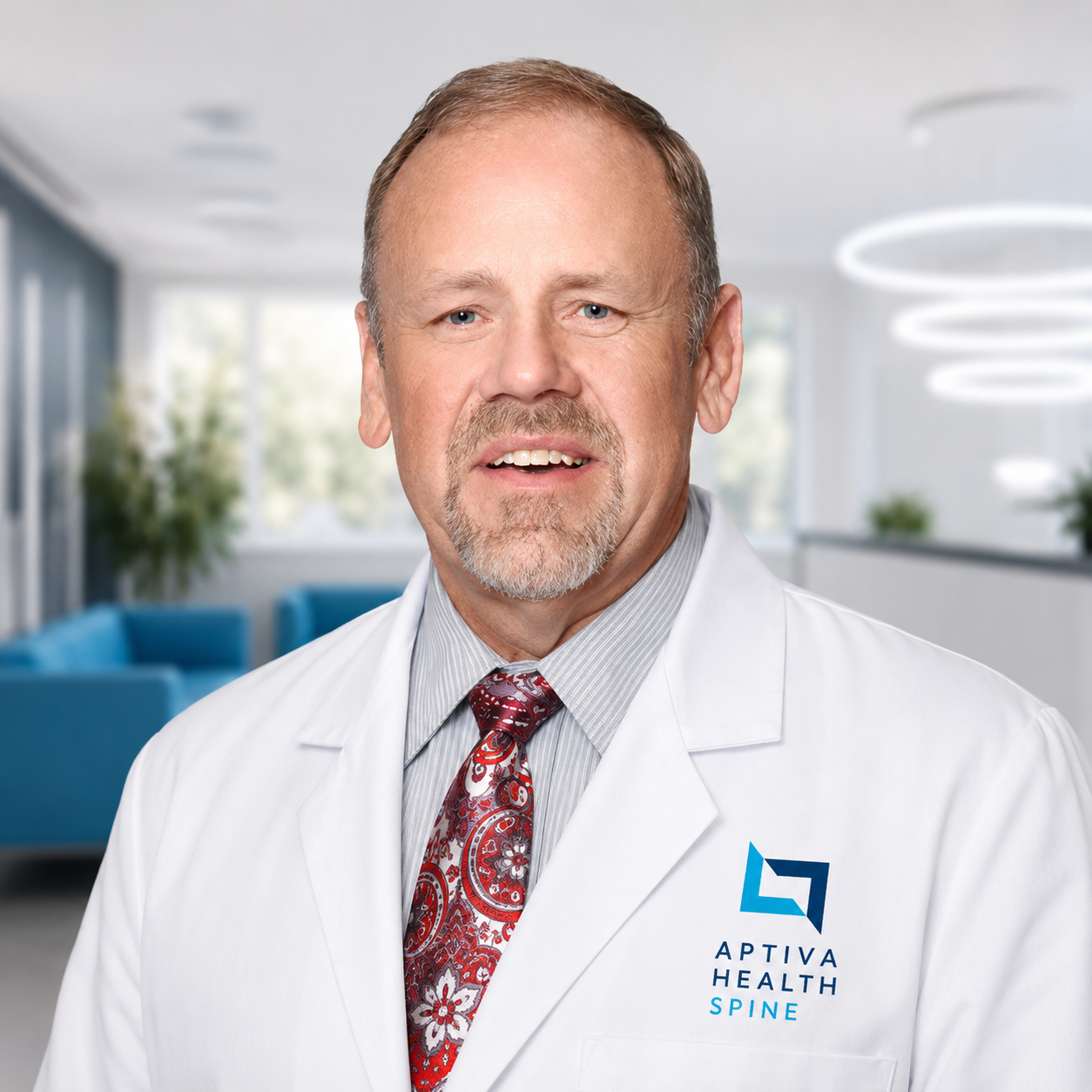
Steven Ganzel, DO | Physical Medicine & Rehabilitation, Interventional Pain Management
Dr. Ganzel is double board-certified in Physical Medicine & Rehabilitation and Interventional Pain Management. For the Aptiva Health Spine Team, he performs fluoroscopy-guided epidural steroid injections, facet joint injections, medial branch blocks, radiofrequency ablation, and other interventional pain procedures for patients — many of which provide lasting relief and prevent the need for surgical intervention.
Schedule an ACL Consultation in Northern Kentucky — Schedule Now
Aptiva Health – Northern Kentucky: 2093 Medical Arts Drive, Hebron, KY 41048
Drive times:
5 minutes from CVG (Cincinnati/Northern Kentucky International Airport)
10 minutes from Florence, KY via I-71/75
12 minutes from Burlington and Union via KY-237
15 minutes from downtown Cincinnati via I-275 East
18 minutes from Covington and Newport
20 minutes from Anderson Township and Mt. Washington (OH)
25 minutes from Price Hill, Westwood, and Delhi Township
30 minutes from Florence Mall and the Boone County line south
Communities we routinely serve: Hebron, Florence, Burlington, Union, Walton, Erlanger, Edgewood, Crestview Hills, Fort Mitchell, Fort Wright, Independence, Covington, Newport, Fort Thomas, Cold Spring, Alexandria, Highland Heights, and across the river in Cincinnati, Anderson Township, Delhi Township, Cheviot, Price Hill, and Westwood.
Hours: Monday–Friday, 8:00 AM – 5:00 PM. Walk-in injury care availability may vary; call ahead to confirm.
Insurance accepted: Most major medical insurance, Medicare, Medicare Advantage, most Kentucky Medicaid plans, workers' compensation, auto injury coverage (PIP and MedPay), and cash-pay.
Frequently Asked Questions About ACL Reconstruction in Northern Kentucky
Do I need surgery for an ACL tear?
Not every ACL tear requires surgery. Treatment depends on factors such as the severity of the injury, knee stability, activity level, associated injuries, and your personal goals. Some patients may be able to manage an ACL injury with physical therapy, strengthening, activity modification, or bracing, while others may benefit from ACL reconstruction. At Aptiva Health Northern Kentucky, D. Philip Stickney, MD evaluates each patient individually and discusses both surgical and nonsurgical options. Dr. Stickney is a board-certified orthopedic surgeon with more than 25 years of orthopedic experience and performs ACL reconstruction and meniscus surgery.
How long is recovery after ACL reconstruction surgery?
Recovery after ACL reconstruction is different for every patient. Returning to higher-level activities and sports can take several months and depends on factors such as the type of graft used, whether other knee injuries are treated at the same time, and progress during rehabilitation. Aptiva Health provides physical therapy at its Hebron location, allowing orthopedic care and rehabilitation to be coordinated within the Aptiva Health system.
What graft is used for ACL reconstruction?
ACL reconstruction replaces the injured ligament with a graft. Common options include tissue from the patellar tendon, hamstring tendon, or quadriceps tendon, as well as donor tissue in selected cases. There are advantages and considerations with each option. Dr. Stickney will discuss graft choices based on your individual injury, activity goals, age, and orthopedic history.
Can a meniscus tear be treated during ACL surgery?
ACL injuries can occur along with other knee injuries, including meniscus damage. When appropriate, a meniscus procedure may be performed during the same surgical episode as an ACL reconstruction. Dr. Stickney performs both ACL reconstruction and meniscus surgery and can determine which treatment approach is appropriate after evaluating your knee and imaging.
How quickly can I be seen for an ACL injury in Northern Kentucky?
Aptiva Health Northern Kentucky offers same-day appointment availability for many orthopedic injuries and concerns at its Hebron clinic. The location also provides MRI and imaging services, physical therapy, immediate injury care, and orthopedic surgery in one location, helping patients move efficiently from evaluation to the next appropriate step in care. The clinic is located at 2093 Medical Arts Drive, Hebron, KY 41048, convenient to Florence, Burlington, Union, Erlanger, Covington, and the Greater Cincinnati area.
What happens if an ACL tear is left untreated?
An ACL tear can affect knee stability, particularly during activities that involve pivoting, cutting, or sudden changes in direction. The impact varies from person to person, so an orthopedic evaluation can help determine the extent of the injury, identify any associated knee damage, and review appropriate treatment options. Patients with a suspected ACL injury can schedule an evaluation with Dr. Stickney at Aptiva Health Northern Kentucky.
Is ACL reconstruction an outpatient surgery?
ACL reconstruction is commonly performed as an outpatient procedure, although the surgical plan and recovery process depend on the individual patient and any additional procedures that may be needed. Dr. Stickney and the Aptiva Health orthopedic team will review what to expect before surgery and coordinate appropriate follow-up and rehabilitation. Aptiva Health lists ACL reconstruction among its outpatient orthopedic procedures.
Who performs ACL surgery at Aptiva Health Northern Kentucky?
ACL care at Aptiva Health Northern Kentucky is led by D. Philip Stickney, MD, a board-certified orthopedic surgeon with more than 25 years of experience in orthopedic care. Dr. Stickney treats knee and sports-related injuries and performs knee arthroscopy, ACL reconstruction, meniscus repair, and partial meniscectomy. He also has experience as a team physician and sees patients at Aptiva Health's Northern Kentucky location in Hebron.
Does insurance cover ACL reconstruction surgery?
Coverage for ACL evaluation, imaging, rehabilitation, and surgery depends on your individual insurance plan and benefits. Aptiva Health Northern Kentucky accepts many major commercial insurance plans, Medicare and Medicare Advantage, Kentucky Medicaid for orthopedic services, workers' compensation, and auto insurance. Patients should confirm their specific benefits and coverage before treatment.
Why are female athletes at increased risk for ACL injuries?
Research has identified several factors that may contribute to ACL injury risk in female athletes, including differences in movement patterns, strength, biomechanics, and neuromuscular control. Risk varies by athlete and sport. Sports-focused strengthening, conditioning, and movement training may be incorporated into an athlete's overall injury-prevention program. Aptiva Health Northern Kentucky offers orthopedic sports medicine and physical therapy services for athletes dealing with knee injuries or working toward a safe return to activity.