

Knee Ligament Surgery - Indianapolis, IN
Aptiva Health provides comprehensive knee ligament care in Indianapolis — from the first evaluation through imaging, conservative treatment, surgery, and rehabilitation — anchored by board-certified sports medicine orthopedic surgery and a team of orthopedic advanced practice providers. We treat MCL, PCL, and LCL injuries, prioritizing conservative care first and offering ligament repair and reconstruction when surgery becomes the right answer. With on-site MRI, on-site physical therapy, and an in-house orthopedic and sports medicine team, the entire knee ligament care pathway happens under one roof.
Medically reviewed by Jason May, MD. Last reviewed: July 2026.
Schedule your appointment today!
The Knee Ligaments
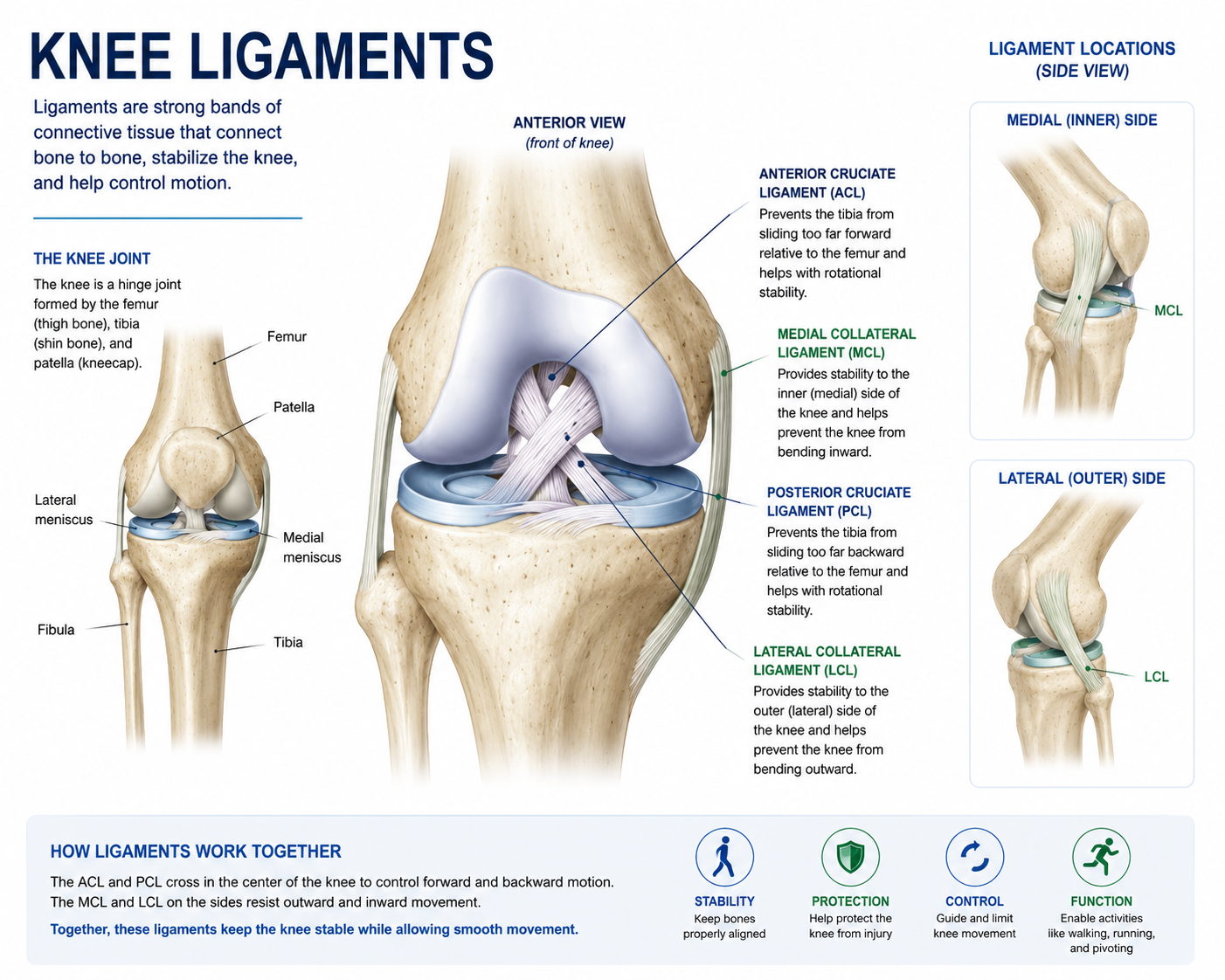
The knee is held together and stabilized by four major ligaments — strong bands of tissue that connect the thighbone (femur) to the shinbone (tibia) and keep the joint moving the way it should:
Medial collateral ligament (MCL) — runs along the inner side of the knee and resists forces that push the knee inward. The MCL is the most commonly injured knee ligament.
Lateral collateral ligament (LCL) — runs along the outer side of the knee and resists forces that push the knee outward. Isolated LCL injuries are less common but tend to be more serious.
Posterior cruciate ligament (PCL) — sits deep at the back of the knee and keeps the shinbone from sliding backward. PCL injuries are often caused by a direct blow to the front of a bent knee.
Anterior cruciate ligament (ACL) — sits at the front of the knee. ACL injuries are treated through ACL reconstruction.
This page focuses on MCL, PCL, and LCL injuries. Aptiva Health's sports medicine team treats all four ligaments, including combined and multi-ligament injuries.
MCL, PCL, and LCL Injuries
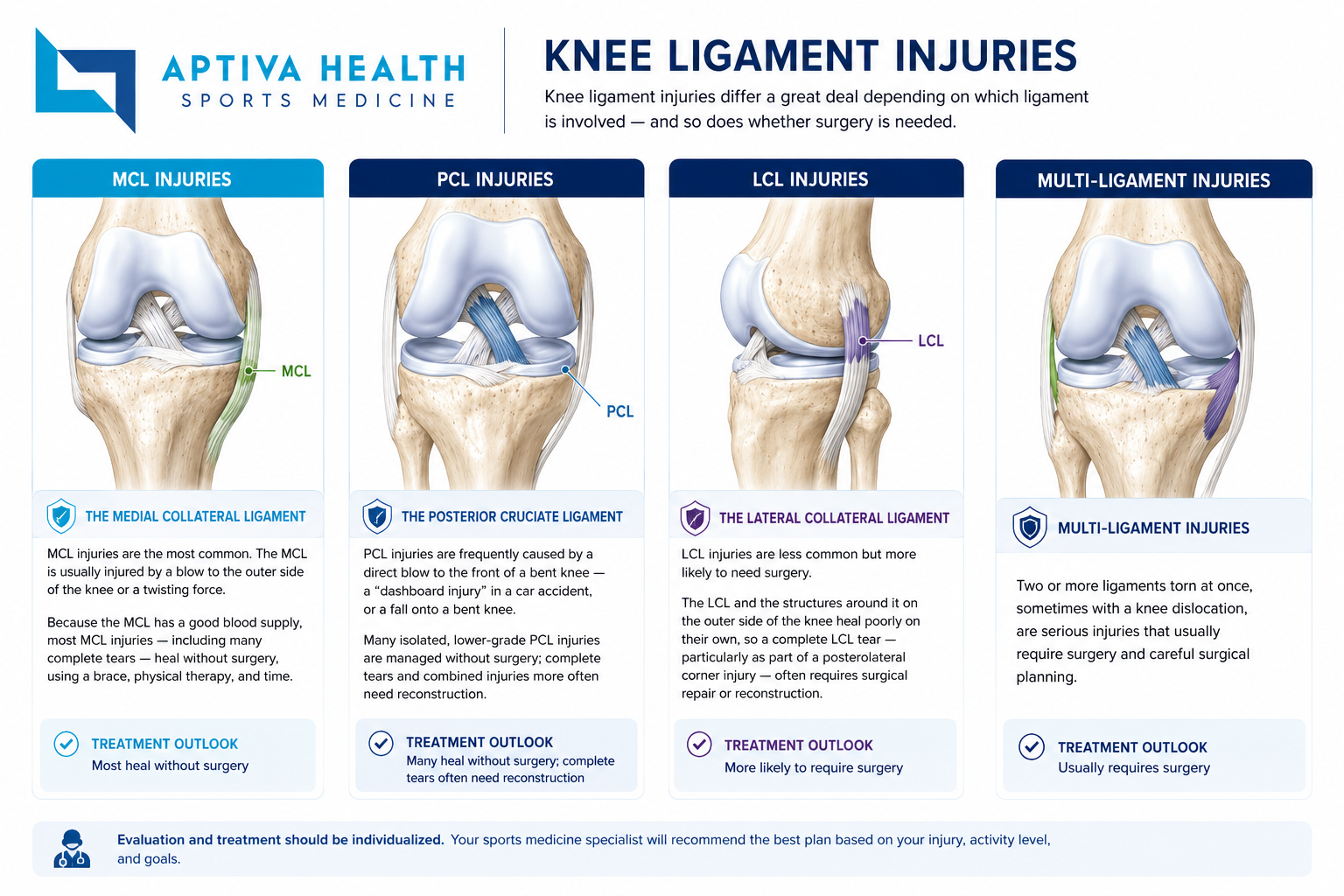
Knee ligament injuries differ a great deal depending on which ligament is involved — and so does whether surgery is needed.
MCL injuries are the most common. The MCL is usually injured by a blow to the outer side of the knee or a twisting force. Because the MCL has a good blood supply, most MCL injuries — including many complete tears — heal without surgery, using a brace, physical therapy, and time.
LCL injuries are less common but more likely to need surgery. The LCL and the structures around it on the outer side of the knee heal poorly on their own, so a complete LCL tear — particularly as part of a posterolateral corner injury — often requires surgical repair or reconstruction.
PCL injuries are frequently caused by a direct blow to the front of a bent knee — a "dashboard injury" in a car accident, or a fall onto a bent knee. Many isolated, lower-grade PCL injuries are managed without surgery; complete tears and combined injuries more often need reconstruction.
Multi-ligament injuries — two or more ligaments torn at once, sometimes with a knee dislocation — are serious injuries that usually require surgery and careful surgical planning.

Grades of Knee Ligament Injuries
Ligament injuries are graded by severity, which guides treatment:
Grade I (mild sprain) — the ligament is stretched with microscopic tearing but remains intact, and the knee stays stable. These rarely require surgery.
Grade II (partial tear) — the ligament is partially torn and the knee is moderately unstable. Treatment depends on which ligament is involved and the patient's activity level.
Grade III (complete tear) — the ligament is fully torn and the knee is unstable. Whether surgery is needed depends on the ligament: many Grade III MCL tears still heal with bracing, while Grade III LCL and PCL tears — and any multi-ligament injury — more often require surgery.

Symptoms of a Knee Ligament Injury
Knee ligament injuries share several symptoms, with the location of the pain often pointing to the injured ligament:
Pain over the injured ligament — on the inner side of the knee for an MCL injury, the outer side for an LCL injury, and the back of the knee for a PCL injury.
Swelling and bruising — usually over the torn ligament within the first few days.
A feeling that the knee is unstable or "gives way" — more pronounced with complete tears.
Difficulty bending the knee or bearing weight.
A pop or tearing sensation at the moment of injury, in some cases.

How Knee Ligament Injuries Happen
Each ligament tends to be injured by a particular kind of force:
MCL — a blow to the outside of the knee that buckles the joint inward, or a twisting injury. Common in football, soccer, and skiing.
LCL — a blow to the inside of the knee that forces the joint outward. Less common, and frequently part of a larger injury.
PCL — a direct blow to the front of a bent knee (a dashboard injury or a fall onto the knee), or a hyperextension injury.
Knee ligament injuries are common in cutting and contact sports and in motor vehicle accidents. They frequently occur alongside other knee injuries, including ACL tears and meniscus tears.
How a Knee Ligament Injury Is Diagnosed
At Aptiva Health, diagnosing a knee ligament injury usually takes a single visit:
History. Your provider asks how the knee was injured, where it hurts, and whether the knee has felt unstable since.
Physical examination. Ligament-specific stress tests — valgus and varus stress testing for the MCL and LCL, and the posterior drawer test for the PCL — identify which ligament is injured and how severe the injury is.
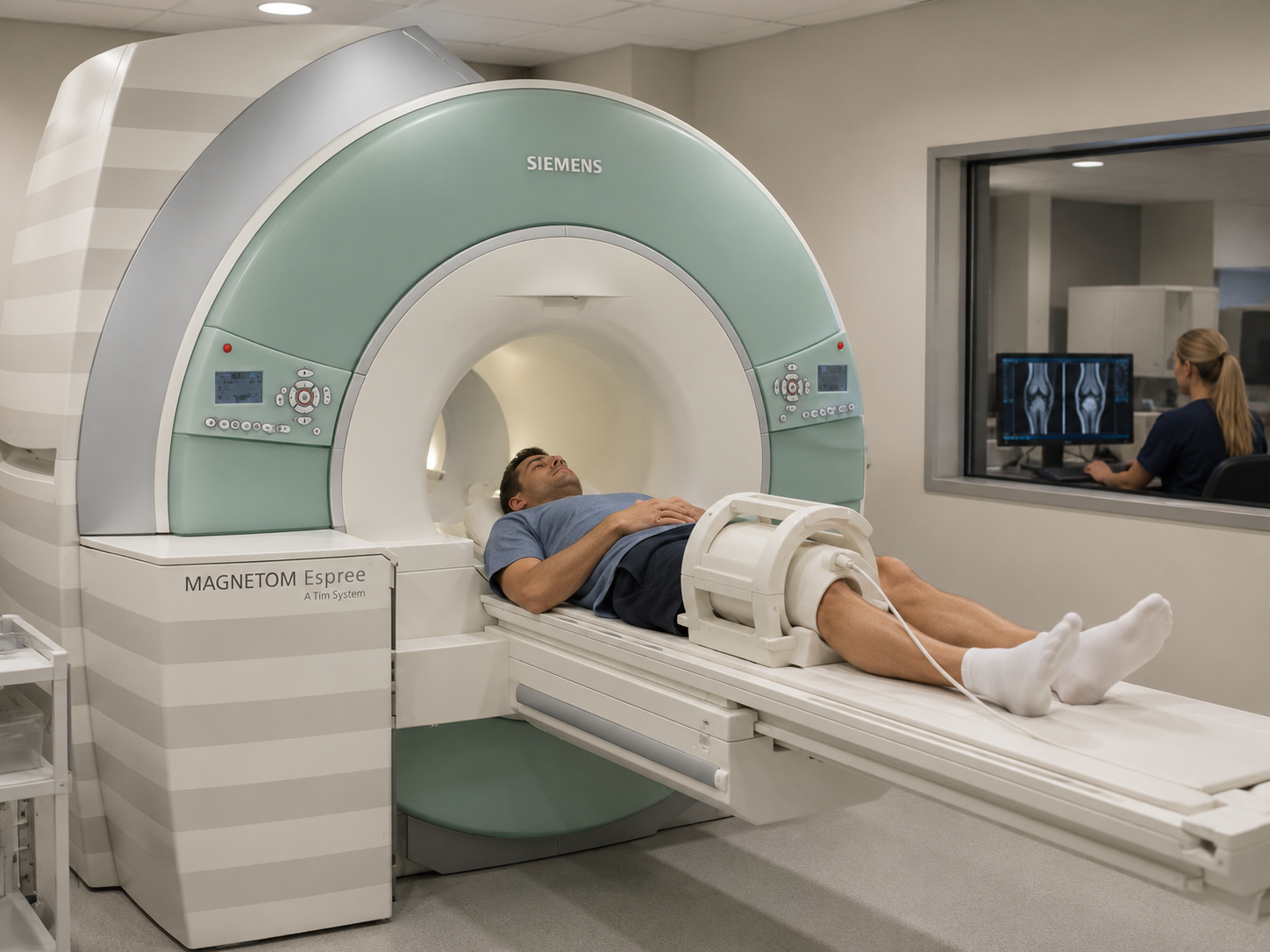
Imaging. An MRI confirms which ligament is torn, shows the severity of the tear, and identifies associated injuries to the other ligaments, the meniscus, or cartilage. Aptiva Health operates its own MRI imaging centers, so most patients can get same-week MRI scheduling without the multi-week wait that hospital-based imaging typically requires.
Treatment plan. After the exam and imaging, your provider walks you through the diagnosis, the surgical and non-surgical options, and the recovery timeline. You leave with a written plan.
Treatment for Knee Ligament Injuries
Treatment depends on which ligament is injured, the grade of the tear, whether more than one ligament is involved, and the patient's activity level.
Non-surgical treatment
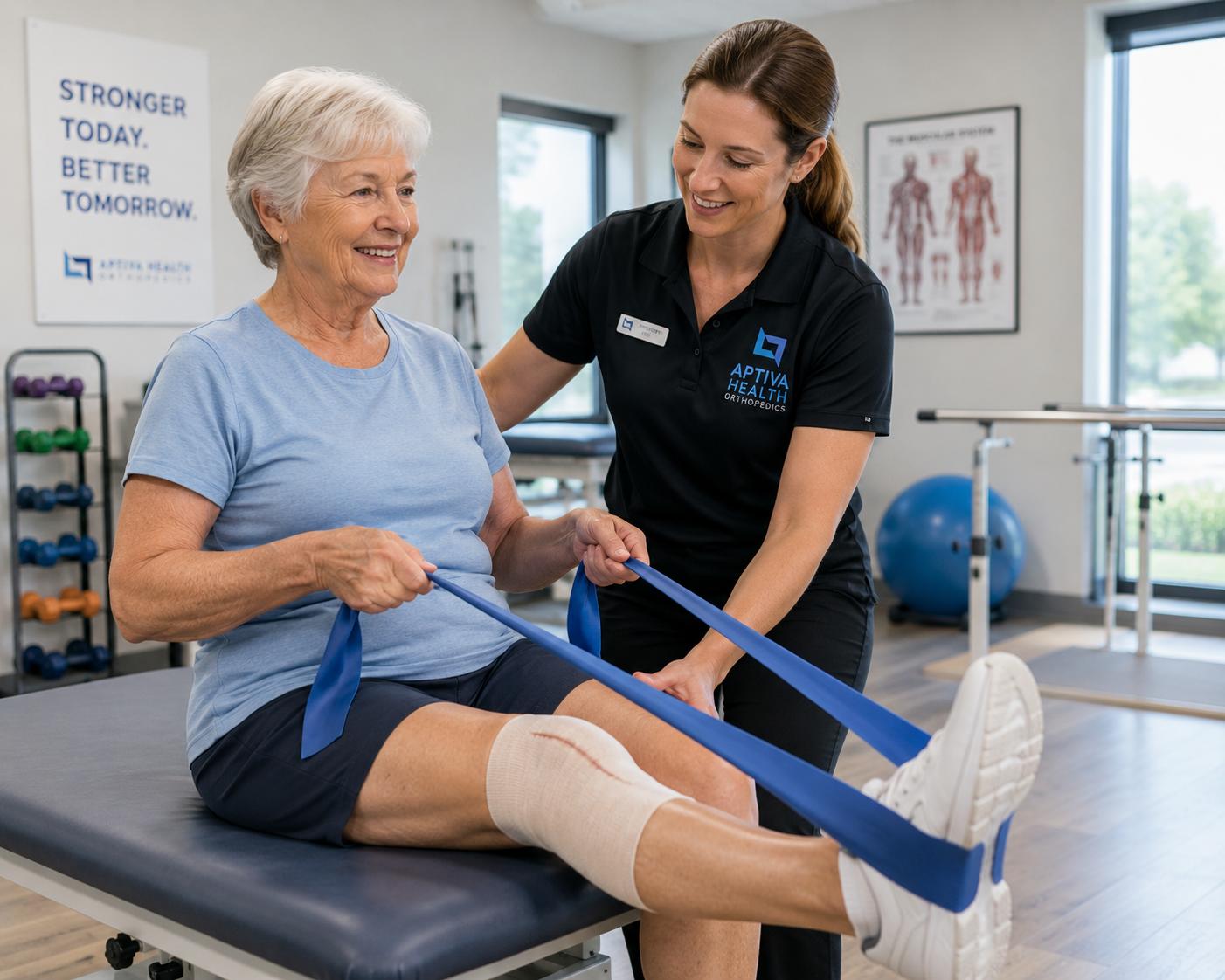
Many knee ligament injuries — most MCL injuries and many isolated, lower-grade PCL and LCL injuries — heal without surgery. Conservative care includes bracing or a knee immobilizer to protect the ligament while it heals, physical therapy to rebuild strength and stability, activity modification, and anti-inflammatory medication. A Grade III MCL tear, for example, often heals over roughly 10 to 12 weeks with appropriate bracing and rehabilitation.
Surgical treatment
Surgery is recommended for complete tears that will not heal on their own — particularly LCL and PCL injuries — for a knee that remains unstable after conservative care, and for multi-ligament injuries. Aptiva's sports orthopedic surgeons perform:
Ligament repair — reattaching or stitching the patient's own torn ligament, used when there is healthy ligament tissue to work with.
Ligament reconstruction — replacing the torn ligament with a graft, used for chronic instability or complete tears that cannot be repaired.
Multi-ligament reconstruction — a coordinated surgical plan addressing two or more torn ligaments.
Learn more about knee ligament surgery procedures →
Repair vs. reconstruction — and the InternalBrace technique
Whenever healthy ligament tissue can be salvaged, repairing the patient's own ligament is preferred over replacing it. When an MCL repair is indicated, Aptiva Health performs it using the MCL InternalBrace technique — a strong suture tape anchored across the ligament that reinforces the repair and helps stabilize the knee while the MCL heals. When a ligament is too damaged to repair, or when chronic instability has set in, reconstruction with a graft restores knee stability.
Recovery
Recovery depends on the ligament and the severity of the injury. A braced ligament injury can recover in several weeks, while a return to sport after a ligament reconstruction typically takes six to nine months — longer for a multi-ligament injury. Aptiva Health coordinates post-operative physical therapy in-house, which keeps rehabilitation on schedule.
Why Patients Choose Aptiva Health for Knee Ligament Care in Indianapolis
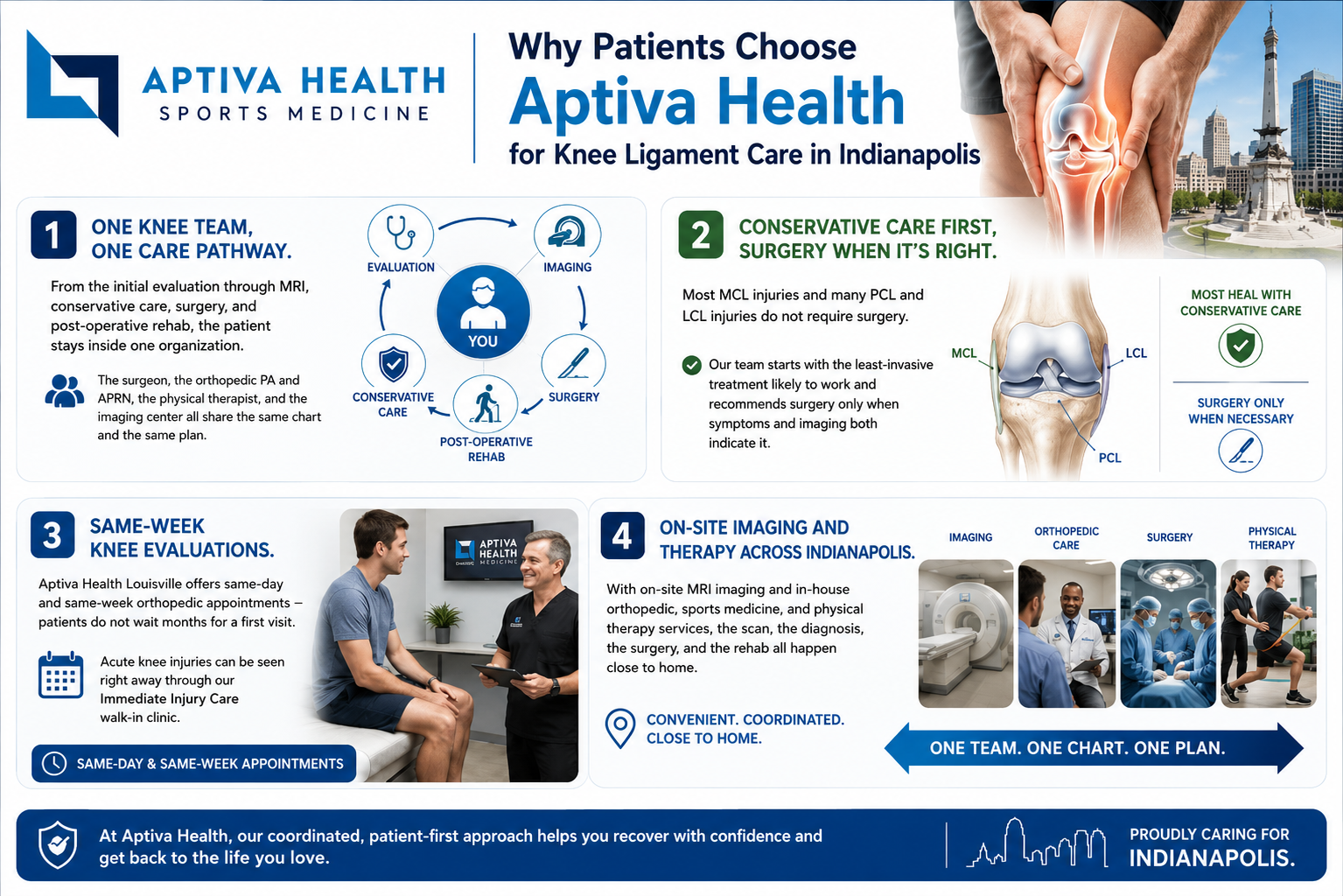
One knee team, one care pathway. From the initial evaluation through MRI, conservative care, surgery, and post-operative rehab, the patient stays inside one organization. The surgeon, the orthopedic PA and APRN, the physical therapist, and the imaging center all share the same chart and the same plan.
Conservative care first, surgery when it's right. Most MCL injuries and many PCL and LCL injuries do not require surgery. Our team starts with the least-invasive treatment likely to work and recommends surgery only when symptoms and imaging both indicate it.
Same-week knee evaluations. Aptiva Health Indianapolis offers same-day and same-week orthopedic appointments — patients do not wait months for a first visit. Acute knee injuries can be seen right away through our Immediate Injury Care walk-in clinic.
On-site imaging and therapy across Indianapolis. With on-site MRI imaging and in-house orthopedic, sports medicine, and physical therapy services, the scan, the diagnosis, the surgery, and the rehab all happen close to home.
Schedule your appointment today!
When to See a Doctor - Call Now!
You should be evaluated by a sports orthopedic surgeon promptly if you experienced:
A knee injury followed by pain over the inner, outer, or back of the knee
Swelling or bruising after a twisting injury, a blow to the knee, or a fall
A knee that feels unstable or "gives way"
Inability to bear weight on the knee
A knee injury from sports, a fall, or a work or auto accident
Get to an emergency room or urgent care immediately if you have an obvious knee deformity, a knee that may be dislocated, inability to bear any weight, or numbness or loss of circulation in the foot — these can indicate a multi-ligament injury, dislocation, or vascular injury.
For non-emergency knee evaluation, Aptiva Health Louisville offers same-day and same-week appointments.
Meet the Indianapolis Knee Ligament Team

Jason May, MD | Orthopedic Surgeon
Dr. Jason May is a board-certified emergency medicine physician and the lead clinician at Aptiva Health's Indianapolis clinic on Gray Road. With more than two decades of hospital-based emergency experience and prior service as Chief of Staff at Columbus Regional Hospital, Dr. May now quarterbacks Aptiva's outpatient injury care model for patients across Central Indiana.
Specialty: Emergency Medicine with extensive orthopedic and trauma care experience
Title:Orthopedic Surgeon / Emergency Medicine Physician
Residency: Indiana University School of Medicine
Medical School: University of Kentucky College of Medicine
Locations: Indianapolis
Accepting New Patients: Yes

D. Philip Stickney, MD | Orthopedic Surgeon
Dr. D. Philip Stickney, a board -certified orthopedic surgeon, has been providing general orthopedic care for over 25 years. He received his medical degree from Case Western Reserve University in Cleveland, Ohio with orthopedic surgery training at Mt. Sinai in Cleveland and Akron General Medical Center in Akron, Ohio. He treats a variety of conditions from arthritis to sports medicine and occupational injuries. As former team physician for Hiram College in Ohio, he has a breadth of experience treating non-operative and operative conditions including:
Specialty: General Orthopedic Surgery
Title: Orthopedic Surgeon, Aptiva Health
Residency: Mt. Sinai Medical Center, Cleveland, Ohio and Akron General Medical Center, Akron, Ohio
Medical School: Case Western Reserve: University School of Medicine, Cleveland, Ohio
Years in Practice: 25+
Locations: Northern Kentucky (Hebron) & Indianapolis
Accepting New Patients: Yes

Robert Williams, MD | Medical Director, General Medicine & Sports Medicine Physician
Dr. Robert Williams is a board-certified Emergency Medicine physician and Medical Director at Aptiva Health, where he specializes in General Medicine, Sports Medicine, acute injury care, and concussion management. With extensive experience caring for patients in emergency medicine and urgent care settings, Dr. Williams is dedicated to providing timely, evidence-based treatment for injuries while helping patients return safely to work, sports, and everyday life.
Specialty: Emergency Medicine, General Medicine, Sports Medicine, Concussion Care
Title: Medical Director | General Medicine & Sports Medicine Physician
Residency: Emergency Medicine – University of Oklahoma Health Sciences Center (2012–2015)
Medical School: University of Kentucky College of Medicine (M.D., 2012)
Locations: Louisville, KY; Indianapolis, IN
Accepting New Patients: Yes

Bradley Stephenson, PA-C | Orthopedic Physician Assistant
Bradley Stephenson is a certified Physician Assistant dedicated to delivering high-quality, patient-centered healthcare. Known for his compassionate approach and strong focus on communication, Bradley strives to ensure every patient feels informed, respected, and cared for during each visit.
Specialty: Orthopedics & Sports Medicine
Title: Physician Assistant
Accepting New Patients: Yes

Bryan Davidson, PA-C, CAQ-OS | Orthopedic Physician Assistant - Aptiva Health
At Aptiva Health, Bryan Davidson, PA-C, CAQ-OS brings advanced orthopedic experience, surgical support expertise, and a compassionate approach to patient care. As a certified Physician Assistant with a Certificate of Added Qualifications in Orthopedic Surgery, Bryan is committed to helping patients feel informed, supported, and confident throughout their orthopedic care journey.
Specialty: Orthopedics & Sports Medicine
Title: Physician Assistant
Schedule a Knee Ligament Consultation in Indianapolis — Schedule Now
Address: 6801 Gray Road, Suite H · Indianapolis, IN 46237
Phone: 463-303-0501 Fax: (855) 859-0123
Hours: Monday–Friday, 8:00 AM – 5:00 PM
Workers' comp scheduling line: 1-844-999-3627
Directions: Located on the south side of Indianapolis, easily accessible from I-65 (Exit 103 Southport Rd), US-31 (East Street), and I-465. Approximately 10 minutes from downtown Greenwood and 15 minutes from downtown Indianapolis.
Insurance accepted: Most major medical insurance, Medicare, Medicare Advantage, most Kentucky Medicaid plans, workers' compensation, auto injury coverage (PIP and MedPay), and cash-pay.
Frequently Asked Questions About Knee Ligament Surgery in Indianapolis
What ligaments does knee ligament surgery treat?
The knee has four major ligaments. This page covers injuries to the medial collateral ligament (MCL) on the inner side of the knee, the posterior cruciate ligament (PCL) at the back of the knee, and the lateral collateral ligament (LCL) on the outer side. The fourth, the anterior cruciate ligament (ACL), is treated through ACL reconstruction. Aptiva Health Louisville's sports medicine team treats all four, including combined and multi-ligament injuries.
Do MCL tears need surgery?
Most MCL injuries heal without surgery. The MCL has a good blood supply, and even many complete (Grade III) MCL tears heal with a brace, physical therapy, and time. Surgery is considered when an MCL tear fails to heal and leaves the knee unstable, or when the MCL is injured along with other ligaments. Your Aptiva Health surgeon reviews your exam and MRI to determine the right approach.
Do PCL tears need surgery?
Many isolated, lower-grade PCL injuries are managed without surgery using bracing, physical therapy, and a focus on quadriceps strengthening. Surgery is more often recommended for complete (Grade III) PCL tears, PCL injuries combined with other ligament damage, or a knee that remains unstable after conservative care. A PCL reconstruction replaces the torn ligament with a graft.
Does an LCL tear need surgery?
Complete LCL tears are more likely to need surgery than MCL tears, because the LCL and the surrounding structures on the outer side of the knee heal poorly on their own. Low-grade LCL sprains often heal with bracing and physical therapy, but a complete LCL tear — especially as part of a posterolateral corner or multi-ligament injury — frequently requires surgical repair or reconstruction. Prompt evaluation is important.
What is the difference between ligament repair and ligament reconstruction?
A ligament repair reattaches or stitches the patient's own torn ligament back together, sometimes reinforced with an internal brace, and is possible when there is healthy ligament tissue to work with. A ligament reconstruction replaces the torn ligament with a graft and is used for chronic instability or complete tears that cannot be repaired. Your surgeon recommends the approach based on which ligament is injured, the tear pattern, and how long ago the injury occurred.
What is the InternalBrace technique for MCL surgery?
When an MCL repair is indicated, Aptiva Health performs it using the MCL InternalBrace technique, in which a strong suture tape is anchored across the ligament to reinforce the repair while the MCL heals. The internal brace acts as a protective support, helping stabilize the knee during recovery.
What is a multi-ligament knee injury?
A multi-ligament knee injury is an injury in which two or more of the knee's major ligaments are torn at the same time, sometimes with a knee dislocation. These are serious injuries that usually require surgery and careful planning. Aptiva Health's sports orthopedic surgeons evaluate and treat combined ligament injuries, often addressing multiple ligaments in a coordinated surgical plan.
How are knee ligament injuries diagnosed?
Knee ligament injuries are diagnosed through a history of how the knee was injured, a physical examination using ligament-specific stress tests, and an MRI that confirms which ligament is torn, how severe the tear is, and whether more than one structure is involved. Aptiva Health operates its own MRI imaging centers, so most patients can get same-week MRI scheduling.
How long is recovery after knee ligament surgery?
Recovery depends on which ligament was treated and the severity of the injury. A braced ligament injury can recover in several weeks, while a return to sport after a ligament reconstruction typically takes six to nine months, and longer for a multi-ligament injury. Aptiva Health coordinates post-operative physical therapy in-house, which keeps rehabilitation on schedule.
Who performs knee ligament surgery at Aptiva Health Indianapolis?
Knee ligament surgery at Aptiva Health Louisville is performed by board-certified sports medicine orthopedic surgeon Jason May, MD, and D. Philip Stickney, MD. Conservative care, bracing, knee injections, and pre- and post-operative management are provided by orthopedic physician assistants Bradley Stephenson, PA-C and Bryan Davidson, PA-C, who work directly with the surgical team.
How quickly can I be seen for a knee injury in Indianapolis?
Aptiva Health Indianapolis offers same-day and same-week orthopedic appointments. New patients with imaging in hand can often be evaluated within the same week of calling. For an acute knee injury, the Immediate Injury Care walk-in clinic can evaluate the knee right away, including on-site X-ray.
Does insurance cover knee ligament surgery?
Knee ligament surgery is covered by most major medical insurance plans, Medicare, Medicare Advantage, and Indiana Medicaid plans. Ligament injuries from a work or auto accident are commonly covered under workers' compensation or auto injury coverage (PIP and MedPay). Aptiva Health verifies benefits before your visit.